

This post is also available in:
 Português
- AT A GLANCE
- Generic Content Is No Longer an SEO Strategy
- The Real Cost Is How Your Business Is Represented
- AI Search Makes Original Evidence More Important
- Generic Content Can Change How Customers See Your Business
- Your Competitive Advantage May Already Be Inside the Business
- Stop Paying for Words. Invest in Evidence.
AT A GLANCE
A $5 article may become one of the most expensive investments your business makes. Cheap, generic content may add pages to a website without adding meaningful evidence of what your company genuinely knows, has experienced, or can do. For an established business, the greater risk is that superficial content becomes part of the digital representation of a company whose real-world expertise is much stronger. Today, your reputation—not your word count—is becoming your greatest digital asset.
Low-cost content is easy to find. Freelance marketplaces and AI tools have made it possible to produce articles quickly and inexpensively, which can sound attractive to a company trying to keep its website active. On paper, it sounds like a dream: cheap, fast, and infinite content to keep your site updated. The problem begins when publishing becomes the objective rather than communicating something worth publishing.
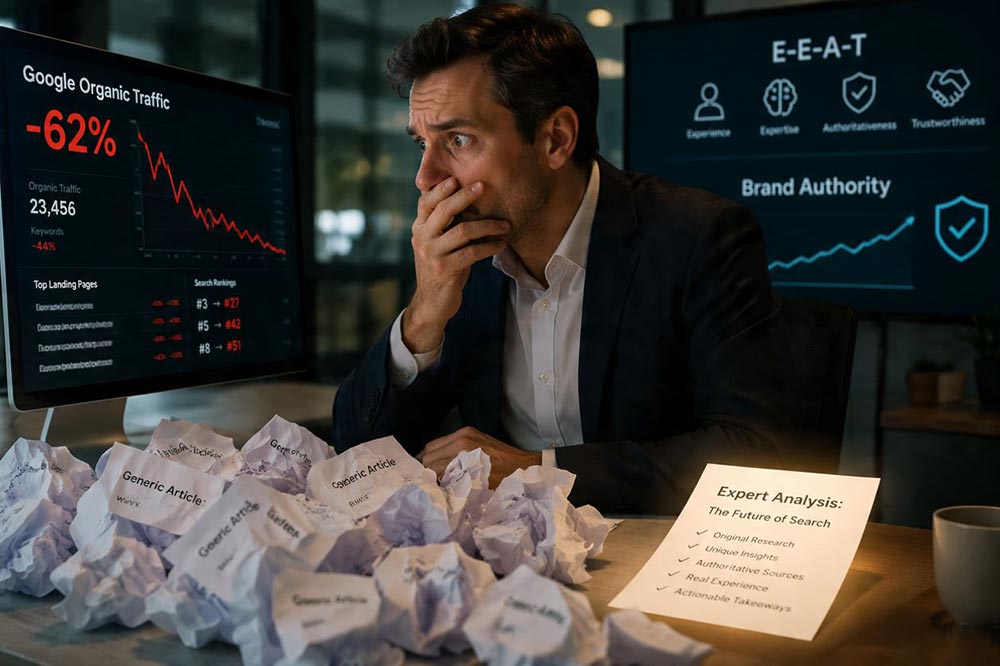
That $5 article can become the most expensive mistake your business makes. The cost is not necessarily the five dollars you paid for it. The real cost appears when generic material becomes what customers, search engines, and AI systems find when they try to understand what your company knows and why it deserves attention.
Generic Content Is No Longer an SEO Strategy
For years, many SEO strategies depended heavily on keywords, publishing frequency, and content volume. Producing more pages could create more opportunities to appear in search results, particularly when fewer competitors were publishing useful information about the same subjects.
That environment has changed. Google has increasingly emphasized helpful, reliable, people-first content rather than pages created primarily to attract search traffic. At the same time, artificial intelligence has dramatically reduced the cost and time required to produce acceptable-looking text. Publishing another article is therefore much easier than it once was, but ease of production does not make the article valuable.
That approach no longer works the way many businesses still expect it to. An article assembled from the same public information used by hundreds of competitors may answer a basic question, but it contributes very little that is unique about your experience, customers, decisions, results, or expertise.

The Real Cost Is How Your Business Is Represented
Imagine a company that has been operating successfully for thirty years. Its people have solved difficult problems, served thousands of customers, survived market changes, developed specialist knowledge, and accumulated lessons that a new competitor simply does not possess. In the real world, that company may have an excellent reputation.
Now imagine that its website contains dozens of superficial articles written only to target keywords. Someone researching the company online does not automatically see those thirty years of experience. They see the evidence the company has made available, and generic content may provide a poor representation of the expertise that actually exists behind the business.
For B2B companies in particular, content often acts as evidence of professional capability. Poor content can therefore create a gap between the quality of the business and the quality of the business as represented online. This is one practical way a Reputation Gap can emerge →: the company may be considerably better than the digital evidence available about it suggests.
AI Search Makes Original Evidence More Important
Customers are no longer limited to scrolling through traditional search results. They can also ask conversational AI systems questions directly and receive synthesized answers. These systems are imperfect and can miss information or misunderstand context, but they add another reason for companies to think carefully about what information exists about their expertise online.
This does not mean every article needs to contain revolutionary research. It means businesses should look beyond endlessly reproducing information already available elsewhere. As explained in why generic content is losing value in the AI era →, the competitive advantage increasingly comes from knowledge and evidence that cannot simply be reproduced from the same public sources.
A cheap article that rearranges information already published elsewhere may create another URL, but it does not necessarily create another reason to trust, remember, recognize, or recommend the business. Original experience, practical examples, first-hand observations, company data, and documented results can provide something fundamentally different.
Generic Content Can Change How Customers See Your Business
The problem is not limited to Google or artificial intelligence. Imagine a high-value potential client arriving on your website because they need help with a complicated problem. They open an article expecting insight from someone who has actually dealt with the situation, only to find a superficial explanation they could have read on hundreds of other websites.
That visitor may begin questioning more than the article. If the content appears generic, inexperienced, or disconnected from the level of expertise the company claims to possess, it can influence how the business itself is perceived. This is particularly important for professional services, high-value B2B companies, specialists, founders, and executives whose knowledge is part of what customers are buying.
“Generic content is destroying your digital reputation. Perhaps your sales are declining because the audience only finds ‘more of the same’ everywhere. In the age of AI, only deep, authoritative content can save your business.” — Mauro Queiroz
Your Competitive Advantage May Already Be Inside the Business
Artificial intelligence can generate explanations, summaries, outlines, and polished marketing copy extremely quickly. What it cannot manufacture is your company’s history: the difficult project your team solved, the lesson learned after a failed strategy, the unusual customer problem that changed your process, or the insight developed after twenty years in the same industry.
The opportunity is to identify those experiences and turn the strongest ones into useful digital evidence. Case studies, expert interviews, original research, customer stories, detailed explanations, photographs, historical records, first-hand observations, and executive insights can all reveal something about the company that generic content cannot.
The goal is not simply to publish more. It is to publish what could only come from someone who has actually done the work. This does not mean AI cannot participate in the process. AI can help research, organize, analyze, edit, and communicate knowledge, but genuine experience must have a genuine source.
Stop Paying for Words. Invest in Evidence.
Your SEO strategy does not need to abandon keywords, useful informational articles, or optimization. It needs to stop treating the existence of another page as an achievement by itself. Before commissioning content, ask what the article will reveal about the knowledge, experience, evidence, or perspective behind your company.
Your editorial and web teams can then make that knowledge easier to discover and understand through clear writing, logical structure, authorship, internal links, structured information, SEO, and modern AI Search optimization. These techniques can help communicate what exists, but they cannot manufacture the expertise or Digital Reputation your company needs to represent accurately →.
In a world flooded with easy-to-produce content, genuine experience becomes more valuable precisely because it cannot be ordered by the word or generated from nothing. Stop paying simply for words and start investing in content that reflects the reputation your business has actually earned.


