



AT A GLANCE
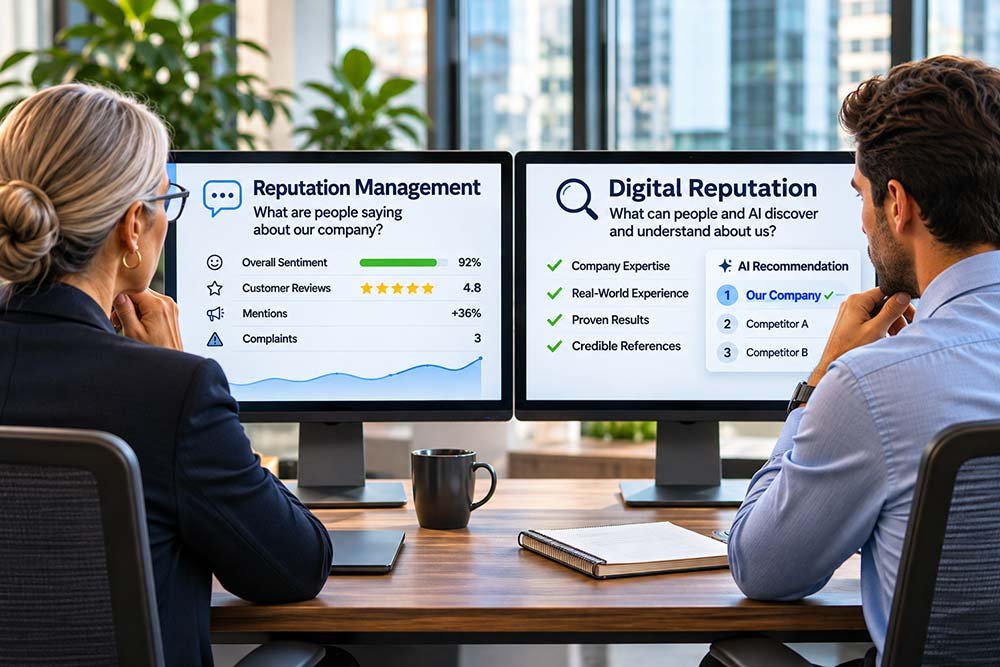
Reputation Management and Digital Reputation are closely related, but they serve different purposes. Reputation Management often focuses on monitoring public perceptions, reviews, complaints, and potential risks. Building Digital Reputation means making a company’s genuine experience, expertise, and achievements discoverable, understandable, and verifiable by people, search engines, and AI systems. Every business can begin this process, regardless of its size, age, or advertising budget.
- AT A GLANCE
- When a Client Thought Their Reputation Was Already Covered
- Reputation Management and Digital Reputation: What’s the Difference?
- Your Reputation Is More Than Your Reviews
- Digital Reputation Is for Every Business
- A New Company Can Start Building Digital Reputation Today
- Why AI Makes Digital Reputation More Important
- How Can You Help AI Understand Your Business?
- The Global Copy Studio Approach: We Help You Build
- Your Next Customer May Not Know You Exist
When a Client Thought Their Reputation Was Already Covered
About a year ago, a client approached Global Copy Studio to discuss Digital Reputation. During our conversation, they explained that another agency was already monitoring their online reputation. They were paying for that service and couldn’t understand why they might need additional help.
I explained that we were discussing two different objectives. Monitoring customer opinions is important, but it doesn’t necessarily help potential customers—or AI systems—understand what a company does, recognize its experience, or discover evidence of its capabilities.
The client eventually decided to pursue our approach alongside their existing reputation monitoring service. The business subsequently appeared in relevant AI-generated recommendations, illustrating the kind of recognition we were working toward, although that outcome alone does not establish which activities caused it.
That experience raised an important question: Is managing what people say about your business the same as building a Digital Reputation that helps new customers discover and understand it?
Reputation Management and Digital Reputation: What’s the Difference?
Online reputation management frequently involves monitoring reviews, customer complaints, news coverage, social media conversations, and public sentiment. In Brazil, for example, many business owners associate reputation management with platforms such as Reclame Aqui, where customers publicly report problems and companies respond.
These activities have value. Customers deserve answers, negative experiences should be addressed, and businesses need to understand how they are perceived. Modern reputation management can also include proactive public relations, content development, and search optimization.

But there is another challenge that monitoring alone cannot solve: How can people who have never heard of your company discover what makes it credible, experienced, and worth considering?
| Reputation Management | Digital Reputation |
| Monitors how a business is perceived. | Documents what a business genuinely knows and does. |
| Addresses reviews, complaints, and reputational risks. | Makes expertise, experience, and achievements discoverable. |
| Helps protect and improve public perceptions. | Helps people and digital systems understand the business. |
| Often involves monitoring and communications services. | Can begin with the owner’s everyday knowledge and a mobile phone. |
| May require specialized resources as complexity grows. | Can begin with modest resources and professional guidance. |
These are differences in strategic emphasis, not mutually exclusive services. A business can benefit from both, but it should understand what each activity is intended to accomplish.
Your Reputation Is More Than Your Reviews
Consider Amazon, eBay, or AliExpress. These companies receive negative reviews, yet millions of customers continue using them because their purchasing decisions involve more than ratings. Familiarity, previous experiences, convenience, reliability, product selection, and perceived value also influence trust.
The same principle applies to a neighborhood business. A barbershop may have relatively few online reviews but employ an exceptionally skilled professional with years of experience and loyal customers. Those qualities are part of its reputation, even when they are poorly documented online.
Reviews deserve attention, but they cannot tell the entire story of a business. They may reveal customer satisfaction or dissatisfaction without explaining professional expertise, specialized knowledge, successful projects, or the reasons behind a company’s decisions.
A company’s reputation is bigger than what customers write about it.
Digital Reputation Is for Every Business
Corporate reputation management is often associated with established organizations that have communications departments, specialized agencies, and substantial budgets. Building Digital Reputation, however, does not need to begin with an expensive campaign or a large team.
Imagine the owner of a neighborhood barbershop. With a mobile phone, the owner can document completed haircuts, explain techniques, introduce employees, and share professional knowledge. With customer permission, the business can also publish genuine experiences that demonstrate the quality of its work.
A consultant can help the owner identify which information matters, how to organize it, and where to publish it. The owner and employees contribute their experience and produce much of the evidence, while the consultant provides direction, technical knowledge, and ongoing guidance when needed.
The same approach applies to a mechanic, an independent professional, a family-owned manufacturer, or a newly established company. A multinational corporation may require a far more sophisticated strategy, but the underlying principle remains the same.
The scale changes. The principle does not.
A New Company Can Start Building Digital Reputation Today
A business does not need decades of history to begin building its Digital Reputation. A new company can start by explaining what it does, documenting its work, introducing the people behind it, and demonstrating how it approaches customer problems.
An experienced founder may bring years of professional knowledge to a newly established business. That experience can support the new company’s credibility, provided it is accurately attributed to the founder rather than presented as achievements the company itself has already completed.
Even a first-time entrepreneur can begin documenting qualifications, processes, completed work, and customer experiences as they develop. Reputation must be earned, but evidence can be created and organized from the beginning.
This is why Digital Reputation should not be confused with buying advertising or producing promotional content. Advertising can attract attention, while genuine evidence gives people something meaningful to evaluate.
Why AI Makes Digital Reputation More Important
For years, businesses invested in Search Engine Optimization (SEO) to improve their visibility in Google search results. SEO remains important, but customers now have another way to research businesses: they can ask ChatGPT, Gemini, Claude, Perplexity, and other AI systems for information, comparisons, and recommendations.
Research published by Bain & Company ↗ indicates that generative AI is becoming part of how consumers research products and how business buyers identify potential suppliers. That means a company may be evaluated through an AI-generated answer before a potential customer visits its website.
AI systems can use information from websites, independent publications, professional profiles, reviews, and other accessible sources. Their answers are not always accurate or complete, and no company can guarantee that an AI platform will recognize or recommend it.
However, businesses can improve the quality, accessibility, and consistency of the information available about them. The objective is not to convince AI that a company is the best. It is to make genuine evidence of its capabilities easier to discover, interpret, and verify.
How Can You Help AI Understand Your Business?
The process does not necessarily begin with sophisticated technology. It begins with identifying what your business knows, does, and has achieved—and asking whether someone unfamiliar with the company could find reliable evidence of those qualities online.
Business owners and their teams can take several practical steps:
- Document real work. Record completed projects, explain challenges, and show how problems were solved, respecting customer privacy and permissions.
- Share genuine expertise. Publish useful explanations, articles, videos, or professional insights based on actual experience.
- Make company information consistent. Ensure that business descriptions, services, professional credentials, and contact information agree across relevant platforms.
- Organize digital evidence. Use clear website pages, meaningful headings, structured data, and connections to credible external sources where appropriate.
- Evaluate recognition. Examine what search engines and AI systems can find and say about the business, identify inaccuracies or missing evidence, and improve the information over time.
A mobile phone may be enough to begin documenting experience. As the business develops, professional guidance can help transform that material into a more structured and accessible digital presence.
Structured data and semantic organization help machines interpret information, but they are not substitutes for credibility. A business still needs real achievements, truthful descriptions, and evidence that can withstand scrutiny.
The Global Copy Studio Approach: We Help You Build
At Global Copy Studio, we believe Digital Reputation belongs to the business, not to the agency or consultant it hires. The people who run a company often understand its customers, expertise, history, and daily challenges better than anyone outside the organization.
Our role is to help those people identify what deserves recognition and communicate it effectively. Depending on the company’s needs, that may involve an assessment, strategic guidance, content planning, technical optimization, executive ghostwriting, or more comprehensive implementation.
We developed the Reputation Journey Framework ↗ to explain how genuine reputation can become recognizable in the digital environment.
Earned Reputation → Evidence → Reputation Transportation → Digital Reputation → Digital Recognition → Recommendation
The journey begins with what a business has genuinely earned. Evidence documents that experience, while Reputation Transportation ↗ helps make it accessible, connected, understandable, and verifiable in digital environments.
That evidence contributes to Digital Reputation ↗, which can support Digital Recognition: people and digital systems identifying a business and understanding what it is known for. Recognition can create opportunities for recommendation, although the final decision remains beyond the company’s control.
Our consulting model can adapt to different resources and needs. A small business owner may need affordable guidance and a practical plan, while an established organization may require an international strategy and specialized implementation.
We do not manufacture reputations. We help businesses make the reputations they have earned recognizable.
Your Next Customer May Not Know You Exist
A business can deliver excellent products, employ experienced professionals, and maintain strong customer relationships while remaining almost invisible to people searching for its services. That problem cannot always be solved by collecting more reviews, increasing advertising expenditure, or monitoring online conversations.
As we discussed in You Used to Create Content to Win Customers. Now You Need to Win AI ↗, companies increasingly need to communicate their experience in ways that both people and AI systems can discover and understand.
For an established business, the challenge may be making decades of experience digitally accessible. For a new business, it may be documenting expertise and building credible evidence from its earliest days.
Neither needs to begin with a large advertising budget. Both can begin by understanding what makes the business credible and taking practical steps to communicate it.
Digital Reputation is for every business. What matters is not how large your company is, but whether the reputation it earns can be discovered, understood, and recognized.


