
What is Digital Reputation?
There aren’t two reputations — one in the real world and another online. Digital Reputation is the reputation you build through what you genuinely do, supported by evidence that people and technology can discover and understand in the digital world. That evidence can come from your work, customer experiences, reviews, articles, photos, videos, achievements and many other real sources.
The word Digital matters because the environment has changed. Websites, search engines, social media, advertising, news, reviews, AI and whatever comes next can all help evidence about you or your company travel further. They do not create your Reputation. What you become recognized for ultimately depends on what you do and the evidence you leave behind.
1. Reputation Is Reputation
Reputation existed long before websites, Google, social media or artificial intelligence. A local business could build its reputation by serving customers for years. People experienced the business, talked about it and learned what they could expect from it.
That basic principle has not changed. Reputation is still built through what you actually do. What has changed is the environment in which evidence of those actions can be discovered and shared.
Digital Reputation is therefore not a second reputation that exists separately from the real world. The noun tells us what it is. The adjective tells us what changed.
Older concepts of Digital Reputation were not wrong. They reflected a time dominated by websites, search results, social media, ratings and reviews. Those still matter, but today’s digital environment has become much broader, bringing together advertising, news, videos, databases, digital evidence, changing human behavior, AI systems that can find and connect information, and whatever comes next (WCN).
2. From Direct Experience to Evidence
If you have visited the same bakery for 20 years, you do not need Google to tell you whether its bread is good. Your reputation judgment comes largely from direct experience. Your neighbors may know the business for the same reason.
Now imagine someone who has never entered that bakery, hired your company or met its executives. Whether that person is one kilometer away or 10,000 kilometers away, the situation is fundamentally different. Before having direct experience, that person needs something else from which to form an initial judgment: evidence.
That evidence can include customer experiences, reviews, photographs, articles, interviews, certifications, awards, historical documents, books, videos, successful projects, business practices, media coverage, employee history, community activities and many other authentic traces of what the company has actually done.
Reviews are therefore important, but they are not Reputation itself. A positive review is one piece of evidence and a negative review is another. Individual opinions are subjective, so a review needs to be understood together with its context and the broader body of evidence about the company.
Nearby, people can experience you. A button away, they need evidence about you.
3. The Reputation Gap: When Reality Is Bigger Than Its Digital Evidence
A company may have been doing excellent work for 40 years while only a fraction of that history can be discovered digitally. Customers may know it. Employees may know it. The owners may have photographs, documents, projects, stories and achievements stored in offices, computers, archives or simply in people’s memories.
The reputation exists, but the available digital evidence does not adequately represent it. This is what we call the Reputation Gap.
The gap can also exist in newer companies. Important work may already be digital but scattered across websites, social networks, customer platforms, databases, videos, news coverage and other sources without enough context or connection to make the larger picture easy to understand.
A Reputation Gap does not necessarily mean a company has a bad reputation. It means what the company has genuinely earned is not adequately represented by the evidence that can be discovered and understood.
4. Reputation Transportation: Helping Evidence Travel
A real experience cannot travel through the internet. Evidence of that experience can. A photograph can show history, a case study can document a result, an interview can reveal expertise, a certification can support competence, and a customer account can describe an experience.
Reputation Transportation is the process of helping authentic reputational evidence move beyond the place where the underlying experience originally happened. Sometimes this means bringing older offline evidence into the digital environment. Sometimes the evidence is already digital but needs context, connection or better representation.
Digitization alone is not Reputation Transportation. Scanning a 30-year-old photograph creates a digital file. Explaining what the photograph shows, why it matters, what it establishes and how it connects with other evidence gives it reputational meaning.
Curation can organize the evidence a person or company chooses to bring forward, but it cannot control all the evidence that already exists or may be created by others. That is why choosing a reputational direction is only the beginning of the journey.
You may have much more evidence than you realize. You simply never looked at your company through a reputational lens.
5. Curation: Discovering What the Evidence Actually Says
Curation begins with a simple question: What does this company legitimately want to be known for? A company has the right to choose that direction, provided the direction is supported by reality. It does not need to give every true fact about itself equal prominence.
Curation cannot invent evidence. It cannot falsify evidence. And it is not meant to work against itself by searching for evidence to undermine the legitimate reputational direction it is trying to support. Its role is to discover, select and connect authentic evidence that shows what a person or company has genuinely done and can legitimately be recognized for.
The next step is discovering the evidence. Sometimes companies already know what they have: reviews, awards, articles, photographs or certifications. Other times the most interesting evidence is hidden in ordinary business practices that nobody previously considered reputationally important.
A company may have used cleaner production methods for years, maintained unusually long employee relationships, supported community programs, invested in professional education, reduced waste or developed practices that demonstrate genuine expertise. Curation identifies those realities, determines what they can legitimately establish, and finds ways to document them when appropriate.
6. You Can Choose the Direction. Reality Determines the Journey.
A company can decide that it wants to become known for exceptional customer service, technical expertise, sustainability, innovation, reliability or another legitimate quality. That is not manipulation. Businesses have always decided what they want to be known for, from newspaper and Yellow Pages advertising to websites, search engines and today’s digital platforms.
But choosing a direction does not guarantee the destination. If a company wants to be recognized for exceptional customer service while customers repeatedly experience poor service, reality will continue producing evidence that conflicts with the desired reputation.
This is why Digital Reputation should never be confused with Good Reputation. Every company can have a reputation. That reputation can be positive, negative, mixed, changing or different depending on the quality being considered.
Advertising, SEO, public relations, websites, social media and other digital channels can contribute to the journey without being Reputation themselves. An advertisement, for example, can lead to a purchase; the purchase creates an experience; the experience may generate a review, recommendation or complaint; and that becomes another piece of evidence.
Sometimes the evidence tells a company that something in the real business needs to change. The company may listen and improve. It may not. We can prepare the way for recognition, but what a company becomes recognized for ultimately depends on the reality and evidence behind it.
7. From Discoverability to Recognition — and Whatever Comes Next
The digital environment has changed again. For many years, people used search engines primarily to find websites and then interpreted the information themselves. Today AI systems can also retrieve information, connect sources, identify entities, summarize evidence and present an interpretation before someone ever visits a company’s website.
This does not make AI the creator of Reputation. It introduces another reader and intermediary into the environment. We still communicate with people, but people are no longer the only ones capable of reading and connecting digital evidence.
That makes discoverability increasingly important. Evidence that cannot be found has limited ability to contribute to recognition outside the people who already know the company. AI Search Optimization, SEO, AEO, GEO and other methods can help evidence become discoverable and understandable, but they cannot manufacture the underlying reality.
Discovery leads to another important question: recognized for what? Digital Recognition is not automatically positive. A company might become recognized for exceptional expertise, reliable products and excellent service — or for repeated complaints and unresolved problems. What a company becomes recognized for depends on what the available body of evidence consistently supports.
Recommendation comes later and remains contextual. Recognition makes it possible for people, search engines and AI systems to connect a company with particular qualities, expertise or experiences, but it does not guarantee that the company deserves to be recommended. You can’t be recommended for what can’t be recognized — and what you are recognized for depends on the evidence.
Technology will continue changing. Search engines will change. AI will change. SEO, AEO and GEO may eventually be replaced by something we have not named yet. This is why the principle must survive Whatever Comes Next.
Perhaps one day we will no longer need the term Digital Reputation. Today, however, the distinction still matters because businesses are operating through this transition. When reputation is routinely built, evidenced, discovered and understood in a digital environment by default, the adjective may become unnecessary — just as many technologies stopped needing the word “digital” once digital became normal.
There was Reputation. We entered the Age of Digital Reputation. Eventually, there may simply be Reputation again.
Understand Your Digital Reputation
Introducing
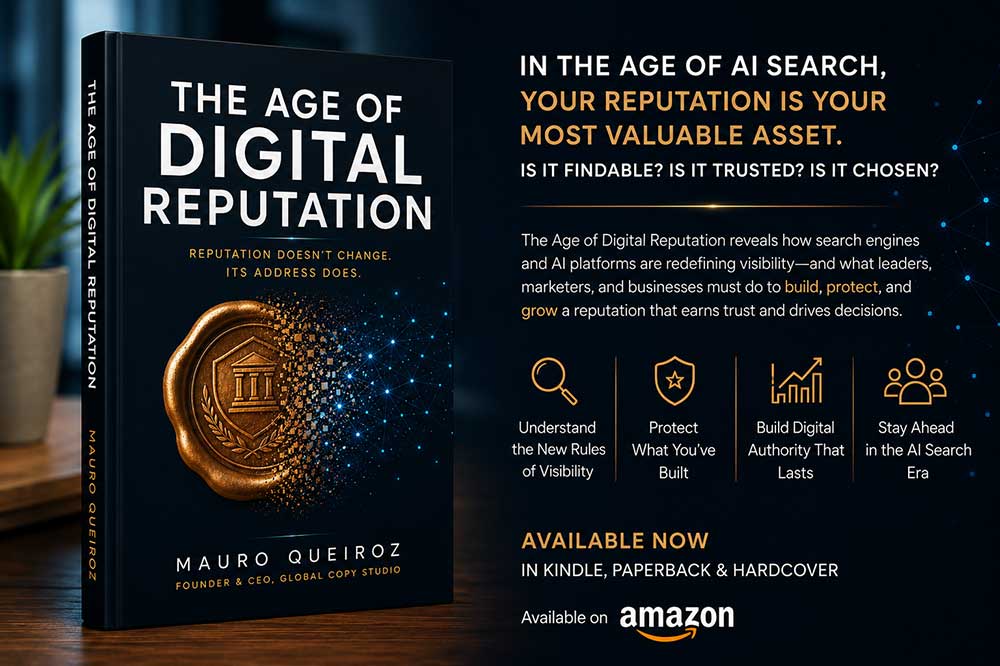
The Age of Digital Reputation
Why the Future Belongs to Businesses That Publish Expertise, Not More Content
The internet has changed. Your reputation hasn't lost its value—it has changed its address. Learn how to transform years of experience into discoverable digital evidence that people, search engines, and AI systems can find, understand, and evaluate.