



AT A GLANCE
Green SEO scores do not guarantee better rankings, more customers, or business growth. Plugins such as Yoast and Rank Math remain useful technical tools, but their scores measure only a limited set of page-level factors. As search expands into AI-generated answers and other forms of discovery, businesses need to look beyond the green circle. Useful answers, original knowledge, genuine experience, and evidence of what your company has actually done cannot be measured by a plugin score.
- AT A GLANCE
- Why “Green Circles” Can Mislead Your Business
- AI Search Is Making the Limitation More Visible
- SEO Still Matters. The Green Light Just Isn’t the Goal.
- AEO, GEO and AI Search Expand the Playbook
- Old SEO Playbook vs. the New Search Playbook
- Three Practical Changes Business Leaders Can Make
- 1. Lead With the Answer
- 2. Turn Real Experience Into Digital Evidence
- 3. Stop Demanding Perfect Green Scores From Your Team
- The Green Circle Is a Tool, Not a Business Strategy
If you own a retail store, run a service business, or lead a company, you’ve probably been told that you need to “do SEO.” To make the process easier, your web developer or marketing agency may have installed an SEO plugin such as Yoast or Rank Math and encouraged your team to improve the page until the little indicator turns green.
Green means optimized. Green means Google will like the page. Green means the job is finished. Right? Not necessarily. The green indicator can be useful, but the problem begins when businesses confuse a tool’s score with the quality and value of the information being published.
Welcome to the age of AI Search. SEO tools have not suddenly become useless, and technical optimization still matters. What businesses need to understand is much simpler: a plugin can evaluate certain characteristics of a page, but it cannot evaluate the full value of your company’s knowledge, experience, evidence, or reputation.
“Many content creators spend hours tweaking text just to chase green dots from an SEO plugin. What a tragic waste of time.” — Mauro Queiroz
Why “Green Circles” Can Mislead Your Business
SEO plugins perform an important job. Depending on the tool and configuration, they can check whether a focus keyword appears in important places, whether titles and descriptions have been completed, whether links are present, and whether the content follows various structural or readability recommendations.
These checks can help writers identify problems they might otherwise miss. The trouble starts when recommendations become writing instructions and the marketing team begins changing useful content primarily to improve a score. A sentence that was perfectly clear may be rewritten simply to insert a keyword again. A heading may be changed because the plugin wants a particular phrase. More words may be added even when the customer already has the answer.
A green score cannot tell you whether an executive shared an insight developed over twenty years, whether a case study contains genuinely useful experience, or whether your article simply repeats information already published by hundreds of competitors. The plugin measures what it was designed to measure. Your mistake is asking it to measure something it cannot.

This is one reason businesses can publish technically optimized pages that sound almost identical to everybody else’s content →. Every competitor can install the same plugin, receive similar recommendations, and turn the same indicators green.
AI Search Is Making the Limitation More Visible
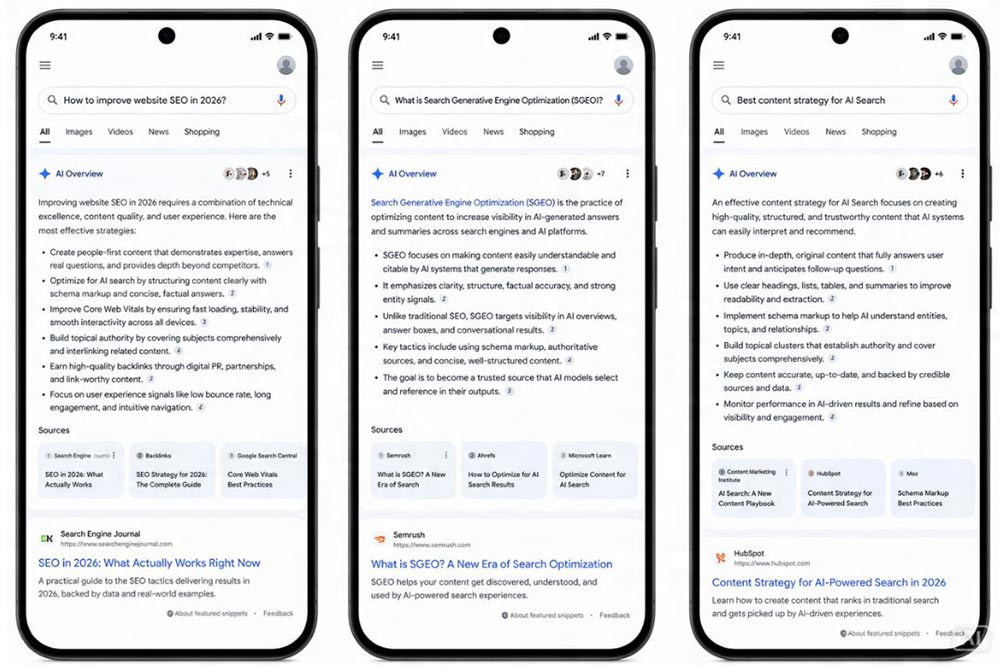
Now consider what happens when a potential customer searches Google. Traditional search results are still there, but Google can also provide information through AI Overviews. People are also asking questions through ChatGPT, Gemini, Claude, Perplexity, and other conversational systems rather than relying exclusively on the familiar list of blue links.
This contributes to a broader change in the discovery journey. A person may learn about a subject, compare possibilities, or receive enough information to continue making a decision without immediately clicking the website that originally published some of that information. Traditional measurements such as rankings, clicks, and organic traffic therefore remain important, but they no longer describe every way a business can be discovered.
SEO Still Matters. The Green Light Just Isn’t the Goal.
The answer is not to uninstall your SEO plugin or stop paying attention to technical optimization. Websites still need descriptive titles, logical structure, crawlable pages, useful internal links, good performance, and information that search engines can understand. Those foundations remain important.
What has changed is the assumption that completing an SEO checklist means the work is finished. A technically optimized page containing generic information is still generic information. A perfect keyword placement cannot manufacture first-hand experience, original research, specialist knowledge, customer evidence, or a distinctive point of view.
This is why the broader principle behind Web Content Optimization (WCO) → matters. The Web environment keeps changing. SEO, AEO, GEO, AI Search, and whatever comes next may introduce different techniques, but businesses still need to make valuable information accessible and useful in the environment where people are discovering it.
AEO, GEO and AI Search Expand the Playbook
AEO, or Answer Engine Optimization, encourages businesses to make important answers clear and accessible. GEO, or Generative Engine Optimization, considers how information is presented in environments where generative AI systems may discover, interpret, summarize, or use information from digital sources.
Neither discipline creates expertise, trust, or reputation. A business earns those things by serving customers, solving problems, developing knowledge, building relationships, keeping promises, and producing results. Optimization can help make evidence of that history easier to discover and understand, but it cannot manufacture the history itself.
Old SEO Playbook vs. the New Search Playbook
The old mistake was to obsess over green indicators, keyword density, rankings, traffic, and publishing volume as though each metric were an objective in itself. Those measurements can still be useful, but they need to serve a larger business purpose.
The emerging search playbook adds another question: What does your company know, possess, or understand that is actually worth discovering? That may include first-hand experience, original data, specialist opinions, customer cases, research, difficult problems your team has solved, or lessons accumulated over years of doing the work.
The objective is therefore not simply to create more pages. It is to make what your company genuinely knows and has experienced visible in ways that people, search engines, and AI systems can understand.
Three Practical Changes Business Leaders Can Make
1. Lead With the Answer
When creating a page or article, do not force customers to read hundreds of words before discovering the main point. Answer the primary question clearly, then provide the explanation, examples, context, and evidence that make the answer useful. This serves busy readers while also creating clearer information for search and AI systems to interpret.
2. Turn Real Experience Into Digital Evidence
Look beyond generic articles that anyone could produce. Your company’s projects, specialists, customer experiences, research, interviews, original observations, and lessons learned can provide evidence that competitors cannot simply reproduce by using the same AI tool or SEO plugin.
Your website is an important part of this process, but it is not the entire digital environment. Independent mentions, interviews, reviews, industry publications, professional profiles, and other credible sources can also contribute to the Digital Reputation → that people and machines encounter when researching your business.
3. Stop Demanding Perfect Green Scores From Your Team
Do not ask your writers to sacrifice clarity, originality, or useful information simply because a plugin wants another keyword or a different sentence structure. Ask whether the page answers a genuine customer question, demonstrates something your company actually knows, and gives the reader a reason to remember or trust the information.
SEO plugins still have a job, so let them do that job. Use their recommendations as signals rather than commandments, and let human judgment decide when following a recommendation improves the page and when it merely improves the score.
The Green Circle Is a Tool, Not a Business Strategy
The greatest danger of SEO plugins is not that they are bad tools. It is that a simple visual score can make a complicated problem look solved. A business leader sees green and assumes the page has been optimized, while the customer may still see generic information that gives no reason to choose that company over another.
Stop optimizing simply to satisfy a plugin. Start making your real knowledge, experience, and evidence easier to discover and understand. Keep the technical tools, keep SEO, and keep measuring performance. Just remember that the green circle was designed to help you optimize a page. It was never designed to define the value of your business.


