

AT A GLANCE
A strong reputation is still one of the most valuable assets a business can have. But in the age of AI Search, the reputation a company has earned also needs to be represented in the digital world. Reviews, articles, interviews, professional profiles, customer experiences, media coverage, historical information and other evidence can help people, search engines and AI systems discover and understand who a company is, what it knows and what it has actually done. Being good remains fundamental. The new challenge is making enough evidence of that reality discoverable.
- AT A GLANCE
- The Age of Digital Reputation
- Your Reputation May Be Stronger Than Your Internet Presence
- There Is One Reputation, but the Digital World May See Only Part of It
- AI Is Changing Who Does Part of the Research
- Your Website Cannot Tell the Whole Story Alone
- More Content Is Not Necessarily the Answer
- The Greatest Risk May Be Digital Invisibility
- Reputation Needs to Travel
- What Can the Digital World Actually See About Your Business?
- The Age of Digital Reputation Has Already Begun
The Age of Digital Reputation
For generations, businesses built their reputations in the real world. They delivered good products, kept promises, solved problems and earned the confidence of customers over many years. That is still how genuine reputation is earned, and no technology changes that.
What has changed is how people discover that reputation. A potential customer may begin with Google or ask ChatGPT, Gemini, Claude or another AI assistant to research a subject, compare alternatives or identify businesses worth investigating. Technology is increasingly participating in the discovery process before a customer ever speaks to a company.
This creates a strange problem for established businesses. A company can be excellent in the real world, respected by customers and well known within its industry, yet surprisingly difficult to discover online.
Being good and being discoverable are no longer the same thing.
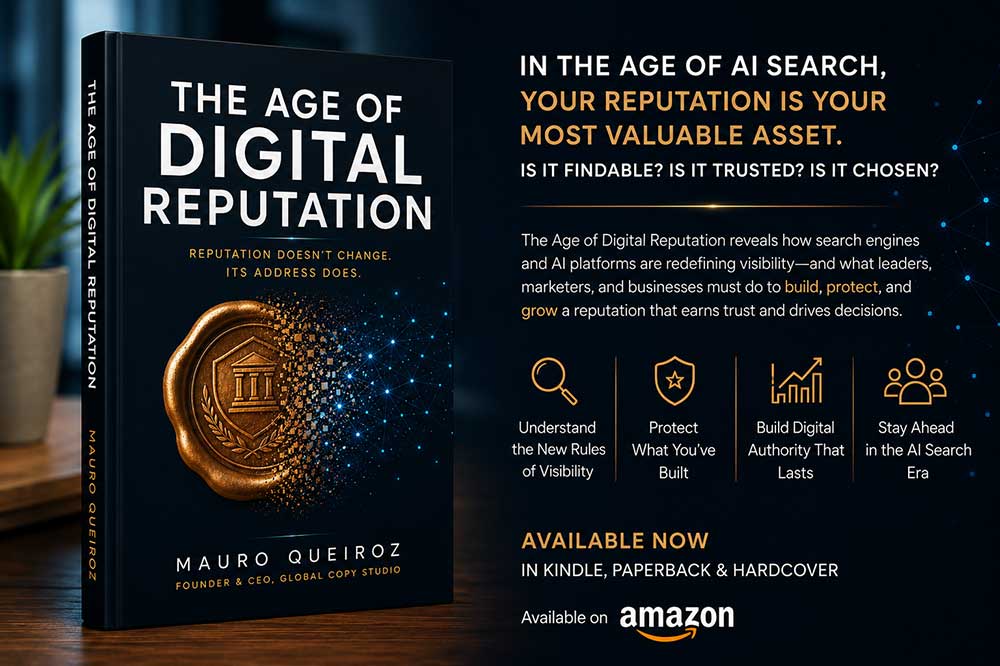
That difference is at the heart of my book, The Age of Digital Reputation ↗. The book explores a simple idea with major consequences for businesses: reputation has not become less important in the digital age. What has changed is how that reputation can be discovered, understood and evaluated.
Your Reputation May Be Stronger Than Your Internet Presence
Imagine a family-owned engineering company that has operated successfully for thirty years. Its customers trust it, its projects are respected and its executives understand their industry deeply. Much of its business comes from referrals and relationships built over decades.
Now imagine someone who has never heard of the company asking an AI assistant to suggest experienced businesses in that field. Perhaps the company has a website with a few service pages and an About Us page, but very few interviews, articles, customer stories, professional profiles or independent references exist elsewhere online.

The company knows it has an excellent reputation, and its customers know it too. But someone discovering the company through the internet may encounter only a small part of that history. Search engines and AI systems face a similar limitation: they can work with information that is available to them, not with decades of experience that remain undocumented inside the company.
The business does not necessarily have a reputation problem. Its real-world reputation may be excellent. The problem is that its digital representation does not adequately reflect what the company has earned.
There Is One Reputation, but the Digital World May See Only Part of It
Reputation begins with reality. It grows from the products a business makes, the customers it serves, the problems it solves, the expertise it develops, the promises it keeps and the results it delivers over time. It exists whether Google recognizes it or not.
Digital Reputation should not be understood as a second reputation invented for the internet. Digital Reputation is the representation of a person or company’s reputation that can be discovered and evaluated through the digital world.
That representation can be shaped by many sources: the company’s own website, reviews, articles, interviews, videos, professional profiles, news coverage, databases, public information, customer experiences and independent references. Together, these can help someone who has never encountered the business understand more of the reputation it has genuinely earned.
This distinction is important enough that we explain it separately in What Is Digital Reputation? ↗. The objective is not to create one reputation for the physical world and another fabricated for the internet. Ideally, the digital representation should reflect reality as accurately as possible.
AI Is Changing Who Does Part of the Research
Before AI Search, customers often did much of the research themselves. They searched Google, opened several websites, read articles, checked reviews and compared companies. Businesses therefore concentrated heavily on getting people to visit their websites.
AI can now perform part of that research for the customer. Someone can ask an AI assistant to explain an industry, compare alternatives, summarize available information or suggest companies worth investigating. Google itself can provide AI-generated answers before someone reaches traditional search results.
This means information about your company may influence the discovery process before a potential customer ever reaches your website. The clearer and more consistent the available information is, the easier it becomes for people and machines to understand what your company does, who is behind it and what evidence exists of its experience.
This does not mean an AI system automatically believes everything it finds online, nor does digital evidence guarantee recognition or recommendation. It means something more basic: what cannot be discovered is much harder to evaluate.
Your Website Cannot Tell the Whole Story Alone
Every company controls what appears on its own website. That makes the website essential, but it also creates an obvious limitation: businesses can say almost anything about themselves.
A company can describe itself as “a leading authority” or “the trusted choice.” Those claims become more meaningful when there is evidence supporting them. It is similar to everyday life. If a professional tells you that they are the best in their field, you probably want to know more before making an important decision.
Customer stories, interviews, professional profiles, media mentions, reviews, industry recognition, original research and articles written from genuine company expertise can all contribute to the wider picture.
Your website tells your story. Evidence beyond your website helps confirm it.
This does not make the company website less important. The website remains one of the few places where a business can clearly organize its identity, expertise, services, people and evidence. But it should not have to carry the entire reputation alone.
More Content Is Not Necessarily the Answer
When businesses realize they are not receiving enough attention online, the reaction is often predictable: publish more. More blog posts, more social media updates and, increasingly, more AI-generated content.
But quantity alone does not create reputation. A company can publish one hundred generic articles explaining the same subjects that hundreds of other websites already explain and still provide very little evidence of what makes its own expertise distinctive.
A better question is: What evidence of our expertise are we creating?
An interview in which a founder explains lessons learned over thirty years has value because those lessons come from experience. Original research can reveal something competitors cannot simply reproduce. A detailed customer story can document what the company actually accomplished. An expert article can preserve professional judgment developed through years of real work.
AI can help organize and communicate that knowledge. But the knowledge itself needs to come from somewhere real.
The Greatest Risk May Be Digital Invisibility
One reason I wrote The Age of Digital Reputation is that this problem can be difficult for successful businesses to notice. Digital invisibility rarely happens overnight. Existing customers still know the company, referrals still arrive and business may continue normally.
Meanwhile, new customers are learning to discover companies differently. They search differently, research differently and increasingly use AI systems as part of that process. A younger competitor with far less experience may become easier to discover simply because more useful information about that company exists online.
That does not necessarily mean the competitor is better. It may simply mean that the digital world has more information available to understand it.
A company can remain excellent while becoming progressively harder to discover.
This is particularly important for established businesses. The more experience, knowledge and reputation a company has accumulated over the years, the more value may remain hidden when only a fraction of that history has reached the digital environment.
Reputation Needs to Travel
A strong reputation should not remain known only inside one community, customer base or professional network. Someone who has never met you should still be able to discover credible evidence of what you know, what you have done and why your business is respected.
A potential customer in another country should be able to understand your expertise. A journalist researching your industry should be able to identify the people who understand it. Search engines and AI systems examining the same field should have enough accessible information to connect the company with the subjects it genuinely knows.
This is an idea I explore more deeply in The Age of Digital Reputation: reputation needs to become transportable.
That idea later developed into what GCS calls Reputation Transportation ↗: identifying meaningful evidence of reputation genuinely earned in the real world, capturing or digitizing it when necessary, providing context, connecting it to the correct people, organizations, expertise, achievements and events, and making it discoverable through the digital environment.
Reputation Transportation does not manufacture reputation. The reputation still has to be earned through real work. The process helps evidence of that reputation travel beyond the people who experienced it firsthand.
Authority is not created by repeatedly calling yourself an authority. Authority has to leave evidence behind.
What Can the Digital World Actually See About Your Business?
There is a simple exercise that can reveal how large your Reputation Gap ↗ may be. Forget for a moment everything you know about your company and everything your long-term customers know about you. Imagine instead that someone encounters your business for the first time today.
Would that person quickly understand what your company is known for? Could they identify the people behind its expertise? Would they find evidence supporting your claims, including credible information beyond your own website? Could they understand important achievements, experience and knowledge that your existing customers already take for granted?
Now consider the same problem from the perspective of a search engine or AI system working with digitally available information.
What evidence would it actually find?
That question matters because the answer may be very different from everything you know about your own business.
The Age of Digital Reputation Has Already Begun
The fundamental rules of business have not changed. Companies still need to do good work, keep their promises, understand their industries, solve real problems and treat customers well. Technology cannot manufacture the genuine reputation created by those actions.
What has changed is the environment surrounding that reputation. It once traveled mainly through conversations, referrals and word of mouth. Websites, search engines, reviews and social networks expanded its reach. Artificial intelligence is now becoming another layer through which people can discover, research and evaluate businesses.
Companies therefore face a new challenge. They must continue earning their reputation in the real world while making sure meaningful evidence of that reputation does not remain trapped there.
That is the deeper argument of The Age of Digital Reputation. The book explores what happens when real-world credibility and digital visibility become disconnected, why producing more content alone does not solve the problem, and why businesses need to make genuine experience, expertise, achievements and recognition discoverable as evidence of the reputation they have earned.
The question is no longer only whether the customers who already know your company trust you.
Can someone who has never heard of you discover enough evidence to understand why they should?


