
AT A GLANCE
SEO, AEO and GEO address different ways content is discovered and understood, but they belong to a bigger discipline: Web Content Optimization (WCO). WCO means preparing content for the Web environment of its time. The technologies, platforms and acronyms will keep changing, but the need to optimize content for the Web will not.
- AT A GLANCE
- I Learned This Lesson From Programming in 1988
- WCO Didn’t Begin With Artificial Intelligence
- The Web Changed, So the Toolbox Changed
- So What Is Web Content Optimization?
- WCO Isn’t Actually a New Term
- WCO Starts Before You Create the Content
- Does Every New Acronym Need to Become a New Service?
- Every Piece of Web Content Is a WCO Decision
- What Comes After GEO?
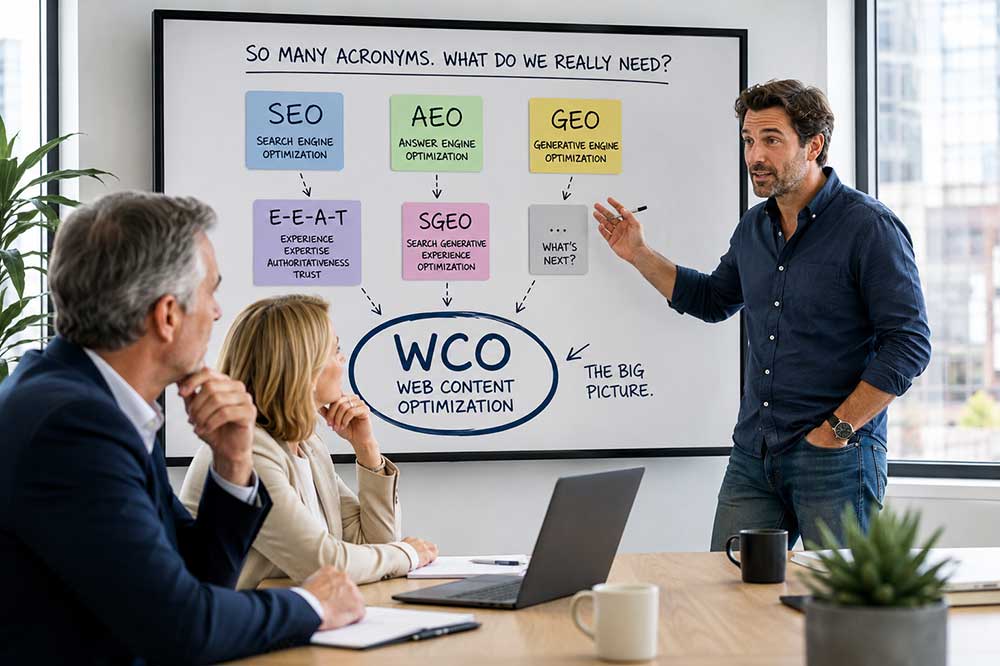
Every few years, the digital industry seems to discover a new acronym. For years, businesses were told they needed SEO. Now we talk about AEO, GEO, AI Search Optimization, Entity SEO and other increasingly specialized disciplines.
Spend a few minutes on LinkedIn and you may leave wondering how many different optimization services your company suddenly needs. These disciplines have value because search is changing, artificial intelligence is changing how information is discovered, and professionals need to understand those changes.
But I think we are sometimes missing the bigger picture.
I Learned This Lesson From Programming in 1988
When I studied Data Processing in 1988, we programmed in FORTRAN, COBOL, Assembly and C. But one of the most valuable things I learned had nothing to do with the syntax of any particular language.
We were taught that if we truly understood programming logic, learning future languages would be much easier. Languages would come and go, but the fundamental way of thinking behind programming would remain.
Thirty-eight years later, that lesson proved remarkably accurate. Technologies changed beyond anything we could have imagined in that classroom, but understanding the logic made adapting to new tools much easier. I believe we should think about Web optimization in much the same way.

SEO matters. AEO matters. GEO matters. AI Search Optimization matters. The next important discipline will matter too. But behind these specializations is a much older and broader responsibility: preparing content to work properly on the Web.
I call that Web Content Optimization, or WCO.
Just as programming logic allowed me to adapt to new languages, WCO provides a way of thinking that can adapt to whatever technologies, platforms and optimization disciplines the Web introduces next.
WCO Didn’t Begin With Artificial Intelligence
Web Content Optimization is not a response to ChatGPT. In practice, we have been dealing with the underlying problem for as long as we have been publishing content online.
Think back to the early 2000s. Many people were accessing websites through dial-up connections, and hosting plans commonly imposed bandwidth limits. Every unnecessary kilobyte mattered.
We used JPEG compressors to make images smaller and HTML compressors to reduce unnecessary page weight. A beautiful 2 MB photograph wasn’t very useful if a visitor had to wait forever for it to appear — and transferring unnecessarily large files could also consume precious hosting bandwidth.
We were optimizing content for the Web we had at the time.
Then websites became more sophisticated. JavaScript, animations, sliders and carousels gave designers exciting new possibilities, but they could also make websites painfully slow. The question changed from simply “Can we build this?” to “Should we put this on the page?”
That was WCO too.
The Web Changed, So the Toolbox Changed
As search engines became the primary gateway to information, SEO grew into an increasingly sophisticated discipline. We learned more about keywords, links, crawlability, site architecture, search intent and countless other factors affecting discovery.
Then smartphones changed how people consumed the Web. Social platforms changed where content lived and how it traveled. Semantic search made meaning and relationships between information increasingly important.
Today, artificial intelligence is changing the environment again. People still use Google, but they can also ask ChatGPT or Gemini a question, encounter Google’s AI-generated answers, or use other systems to research products, companies and ideas.
The WCO toolbox can include SEO, AEO, GEO, Entity SEO, accessibility, authorship, structured information and principles such as E-E-A-T. AI Search Optimization brings together several disciplines to help make a digital presence easier for AI-influenced discovery systems to discover, understand and evaluate.
WCO can also involve decisions about how genuine experience, history, expertise and reputation should be represented through Web content. The precise techniques change because the environment changes.
The toolbox became larger because the Web became more complex.
So What Is Web Content Optimization?
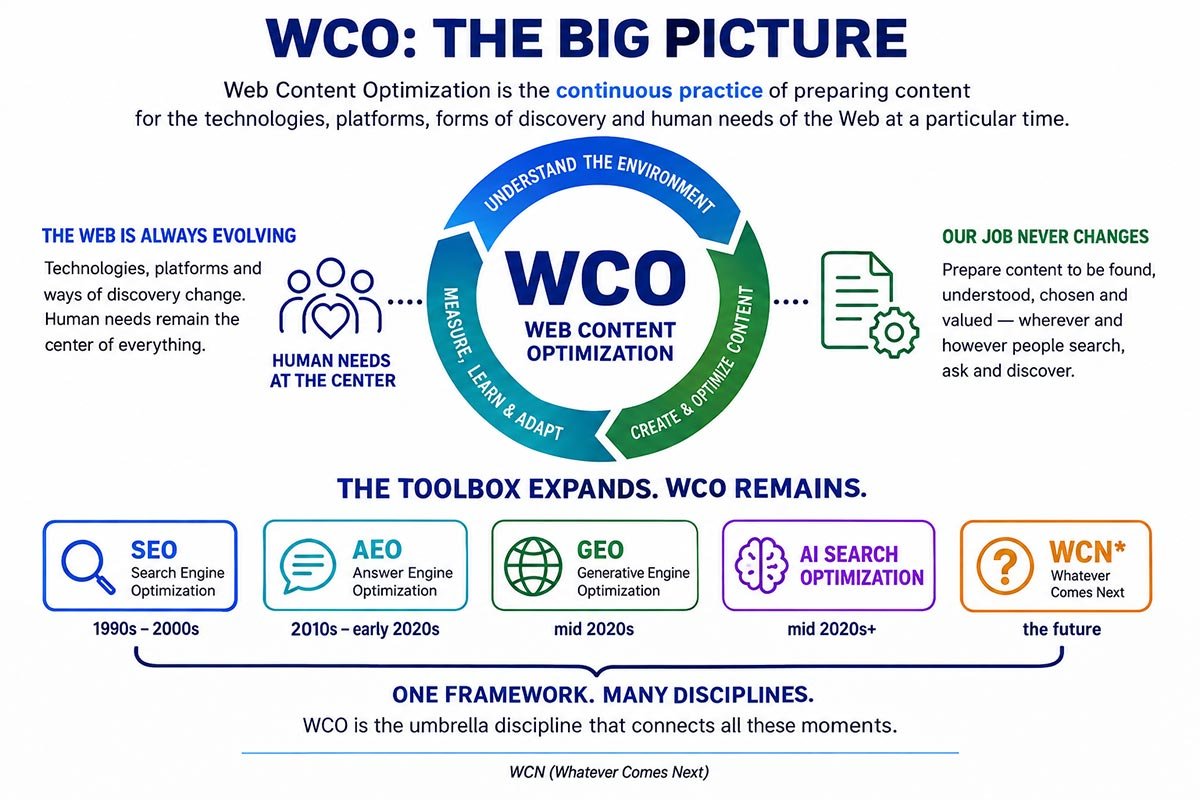
I define Web Content Optimization (WCO) as the continuous practice of preparing content for the technologies, platforms, forms of discovery and human needs of the Web at a particular time.
That definition is intentionally broader than Search Engine Optimization. WCO can begin before a single word is written and continue after something has been published. It influences what we create, how we structure it, where we publish it, how we connect it to a larger digital presence and how we improve it over time.
An article can go through WCO. So can a service page, photograph, YouTube video, Instagram post, executive biography or product description.
Even publishing a book on Amazon involves WCO thinking. The description, author information, categories and other information should be considered in relation to how people will discover, understand and evaluate that book.
Different environments require different techniques. The underlying logic remains the same.
WCO Isn’t Actually a New Term
Web Content Optimization isn’t a new expression. WCO was already being used more than a decade ago, particularly for technologies designed to make web pages faster and more efficient through improvements to HTML, JavaScript, images and content delivery.
I don’t think that use was wrong. I think we came to understand the term too narrowly.
Making a JPEG smaller was Web Content Optimization. Making a page easier for Google to understand is Web Content Optimization. Structuring information so it can be clearly understood in an AI-influenced discovery environment can be Web Content Optimization too.
The technologies changed. The underlying responsibility didn’t: prepare content for the Web as the Web exists at that moment.
That’s why I use WCO today as the umbrella rather than another competitor to SEO, AEO or GEO. Those disciplines sit inside it. And when the next acronym arrives? I simply call it WCN: Whatever Comes Next.
Whatever Comes Next doesn’t replace WCO. It changes what WCO requires.
WCO Starts Before You Create the Content
This is where I believe an important change in mindset is necessary. The old workflow was often: write the article, finish the website or upload the product — and then ask someone to “do the SEO.”
That separation makes less sense today. Before an executive article is written, for example, we should understand why it needs to exist. What question does it answer? What genuine experience does the executive bring to the subject?
We should also ask how it connects with other things that person or company has published and what evidence it contributes to their reputation and areas of expertise. These questions belong at the beginning of the process, not at the end.
The same principle applies to video, social media and websites. Optimization should not be something sprayed over finished content at the end of production. WCO should influence the decision to create the content in the first place.
Does Every New Acronym Need to Become a New Service?
This is where I sometimes disagree with the way our industry presents technological change. Look at LinkedIn and you will find SEO services, AEO services, GEO services, AI Search services and increasingly specialized offerings.
There is nothing inherently wrong with those disciplines or with specialists offering them. What I question is whether every new optimization discipline necessarily needs to become another separate service that businesses are told they must buy.
If optimizing a company’s Web presence now requires additional research, technical work, better organization of information or specialized knowledge of AI Search, then the workload has increased. Professionals should adjust their scope and fees accordingly.
But from the client’s perspective, something simpler has happened: The Web changed, so the work required to properly prepare their content for the Web changed too.
The business owner should not need to decide whether an article requires SEO, AEO, GEO, Entity SEO, AI Search Optimization or whatever acronym arrives next. Understanding what the Web requires is our responsibility as professionals. The client needs to know that their content will go through an appropriate Web Content Optimization process before it represents their business online.
The business owner does not need to master every new acronym. What matters is whether the digital world can find enough authentic information to understand the business, what it has done and what it should genuinely be known for. That can contribute to the conditions for Digital Recognition ↗.
Every Piece of Web Content Is a WCO Decision
This is particularly important today because a company’s reputation is represented online by much more than its website. A founder may publish an article, appear in a YouTube interview, post a video on Instagram, write a book, contribute to another publication and maintain professional profiles across several platforms.
A company may have decades of experience, successful projects, satisfied customers and genuine expertise while very little of that history is properly documented online. The distance between what exists in the real world and what the digital environment can discover and understand can create a Reputation Gap ↗.
Together, those pieces can contribute to the Digital Reputation ↗ of a person or company — the representation of their reputation that can be discovered and evaluated through the digital world.
WCO therefore isn’t only about rankings. It is also about asking what each piece of Web content contributes to the larger picture.
Does it make the person or company easier to understand? Does it document genuine experience? Does it reinforce an area of expertise? Does it connect logically with the rest of their digital presence?
Does it help a potential customer make a better decision? Sometimes WCO may even tell us not to publish something. More content is not automatically better content, just as adding another JavaScript carousel did not automatically make a website better twenty years ago.
What Comes After GEO?
I don’t know. Perhaps five years from now we will be discussing optimization disciplines that do not exist today.
New devices, AI agents, interfaces and ways of accessing information will create new challenges, and someone will inevitably give those challenges new acronyms. That’s fine. We should study them.
We should learn the methods that prove useful, discard those that don’t and add the valuable ones to our professional toolbox. But we shouldn’t confuse the latest tool with the enduring discipline.
When I learned programming almost four decades ago, I couldn’t possibly know which languages and technologies I would encounter throughout my career. Learning the logic gave me a foundation for adapting when they arrived. I believe the Web demands the same mindset.
The acronyms will change. The methods will evolve. The platforms will come and go. But as long as we publish content on the Web, we will need to prepare it for the Web we have.
That is WCO.


