


AT A GLANCE
A luxury eyewear retailer had invested for years in SEO and high-quality content. Its pages continued ranking well, yet qualified organic traffic began declining. The problem was not simply rankings. Customer discovery was changing as Google AI Overviews and conversational AI systems increasingly answered questions before users visited websites. This real Global Copy Studio case shows why businesses need to look beyond rankings and make their genuine expertise, experience, and evidence easier for people, search engines, and AI systems to discover and understand.
- AT A GLANCE
- The Business Had Done Everything Right
- When Good Rankings Stopped Producing the Same Traffic
- The Zero-Click Problem
- Why Traditional SEO Was No Longer the Whole Strategy
- Rebuilding the Strategy for the AI Era
- 1. Build Knowledge, Not Random Articles
- 2. Document Real Experience
- 3. Answer the Questions Customers Actually Ask
- 4. Make Expertise Easier to Understand
- Results Require Patience
- The Lesson Every Business Should Learn
The Business Had Done Everything Right
Editor’s Note: This case study is based on a real Global Copy Studio project. Some details have been modified to preserve client confidentiality while accurately reflecting the strategy, methodology, and results.
For years, the owner of a successful luxury eyewear retailer followed what most digital marketing professionals recommended. Rather than relying entirely on paid advertising, she invested consistently in useful content, technical SEO, and organic visibility. The website published educational articles, ranked for important searches, and became a valuable source of qualified traffic for the business.
The strategy worked. Potential customers found the website through Google, learned about premium eyewear brands, compared products and technologies, and moved closer to a purchasing decision. As long as important pages continued ranking well, there was every reason to expect that qualified search traffic would continue arriving.
Then, around the middle of 2025, something changed.
When Good Rankings Stopped Producing the Same Traffic
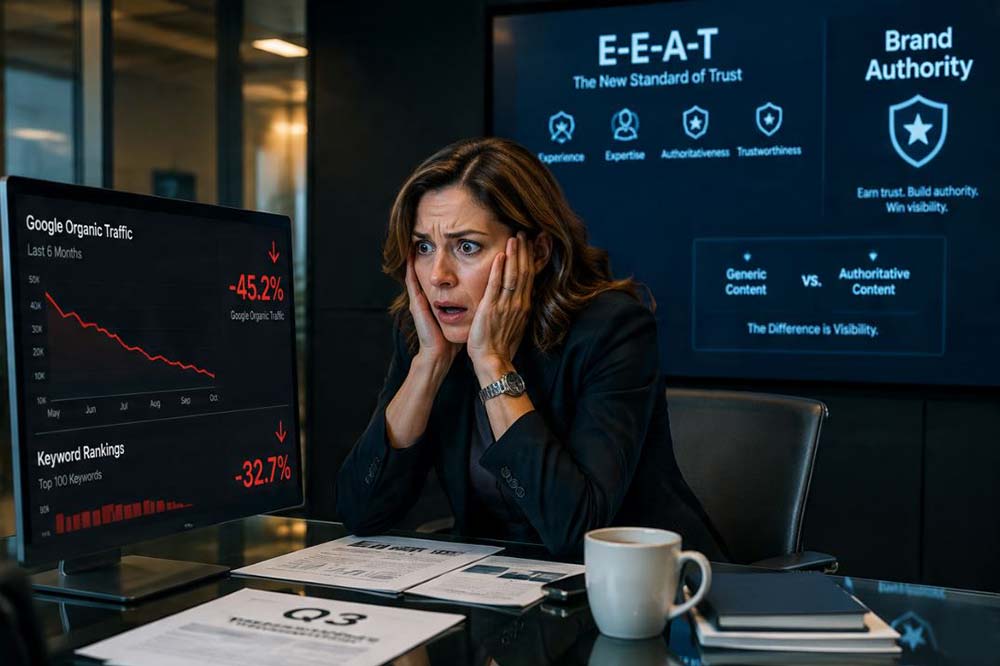
Website traffic began falling sharply. The first assumption was that something technical had gone wrong, so the website was checked for indexing problems, performance issues, ranking losses, and other common SEO problems. Nothing obvious explained the size of the change.
Many important pages were still visible in Google, and several valuable search terms continued performing reasonably well. Yet the relationship between rankings and qualified website visits was no longer behaving as the business had come to expect.

This was the important clue. The website had not suddenly lost all of its value. The environment between the customer’s question and the website was changing.
The Zero-Click Problem
I call this the Zero-Click Problem. It describes a growing business challenge in which appearing prominently in search does not necessarily produce the same level of website traffic because users can obtain information directly from search results, AI-generated answers, and conversational systems without immediately visiting the original websites.
For years, the customer journey was relatively predictable. Someone searched Google, reviewed a list of results, opened several websites, compared information, and gradually reached a decision. A high ranking therefore had a relatively direct relationship with the opportunity to earn a visit.
Today, that journey can be different. Google AI Overviews can provide information directly in search, while ChatGPT, Gemini, Claude, Perplexity, and other AI systems allow people to ask detailed questions and continue the research as a conversation.
This does not mean clicks are disappearing or websites are becoming irrelevant. It means ranking and receiving the click are no longer as tightly connected as businesses once assumed. That distinction is at the heart of The End of the Click ↗.
Why Traditional SEO Was No Longer the Whole Strategy
When we reviewed the project, we did not conclude that SEO had stopped working. The website still needed strong technical foundations, useful pages, clear architecture, and search visibility. Abandoning SEO would have made little sense.
The problem was that the strategy had been designed primarily around the traditional journey from ranking to click. It gave much less attention to how the retailer’s genuine expertise was represented, connected, and supported by evidence throughout its digital presence.
That distinction became increasingly important as discovery expanded beyond traditional search results. Ranking well and becoming a useful source in an AI-assisted discovery environment are related objectives, but they are not exactly the same objective.
Rebuilding the Strategy for the AI Era
Our objective was not simply to recover a few ranking positions. We wanted to make the retailer’s genuine knowledge and experience easier to discover, understand, and associate with the business behind it. That required changes to the content strategy rather than another round of keyword adjustments.
1. Build Knowledge, Not Random Articles
Instead of treating every article as an isolated opportunity to target a keyword, related subjects were organized more logically. Luxury lens technology, premium frame materials, designer collections, prescription lenses, eyewear care, and other important topics could support one another rather than existing as disconnected pieces of content.
The objective was to create a clearer body of knowledge. Customers could move naturally between related subjects, while the site’s structure provided more context about what the retailer genuinely understood.
2. Document Real Experience
Generic explanations of eyewear products were not enough to represent the business. The retailer possessed something much more valuable: years of experience helping real customers choose premium frames, lenses, materials, and solutions for different needs.
We strengthened information about the people behind that expertise, incorporated practical questions customers actually asked, and placed greater emphasis on knowledge developed through real work. The objective was not to invent expertise for the website. It was to make existing expertise visible.
3. Answer the Questions Customers Actually Ask
The content strategy also moved beyond writing primarily around keywords. Important pages were reviewed around the questions customers ask when researching premium eyewear, with clearer answers followed by useful explanations, examples, and professional context.
This naturally supports AEO, or Answer Engine Optimization, and GEO, or Generative Engine Optimization. More importantly, it makes the information better for the customer. These approaches form part of the broader AI Search Optimization strategy ↗, rather than replacing SEO.
4. Make Expertise Easier to Understand
We also improved the relationships between information across the website. Internal links connected related subjects more logically, content architecture was simplified where necessary, and structured information helped reduce ambiguity around products, brands, people, services, and other important entities.
The goal wasn’t simply helping Google crawl the website. It was making the business and the evidence behind its expertise easier for people and machines to understand.
Results Require Patience
One of the biggest misconceptions about AI Search is that businesses can change a few pages and expect an immediate transformation. Search visibility, customer behavior, competitive conditions, and AI-assisted discovery involve many variables outside a company’s direct control.
For several months, there was no dramatic turnaround. Rankings fluctuated and traffic remained under pressure. Around six months after the broader strategy began to be implemented, however, we observed a more encouraging pattern: organic visibility stabilized, qualified traffic improved, and the retailer began appearing in AI-generated discovery experiences relevant to its market.
We should not claim that every improvement came from a single optimization or that the same strategy will produce identical results for another company. The case demonstrated something more useful: the business could adapt its digital presence without abandoning SEO by making its genuine expertise and evidence a much larger part of the strategy.
The Lesson Every Business Should Learn
Many companies still respond to declining organic traffic by producing more articles, buying more software, or trying to move a few positions higher in Google. Sometimes those actions are appropriate, but they should not begin until the business understands why the relationship between visibility and traffic has changed.
The businesses most likely to succeed over the next decade will be those that transform their experience into knowledge and evidence that people and machines can find, understand, and connect to the business behind it.
The website remains essential because it gives a business a place to document its expertise, explain its services, organize knowledge, and provide evidence under its own control. But the website now operates within a much larger discovery environment that includes search engines, AI systems, reviews, media, professional platforms, databases, and other digital sources.
That is why declining clicks should not automatically lead businesses to conclude that SEO has failed. The better question is whether the company’s digital presence accurately represents what the business genuinely knows and has achieved. When the answer is no, the problem may extend beyond traffic into the company’s Digital Reputation ↗.
In the Zero-Click era, rankings still matter and clicks still matter. But neither metric alone can tell you whether your business is being discovered, understood, and recognized where customers are increasingly making decisions.


