

AT A GLANCE
AI Search is changing how customers discover businesses. Google AI Overviews, ChatGPT and other AI tools can increasingly answer questions, compare options and help people research companies before they visit a website. SEO still matters, but ranking alone is no longer enough. Businesses also need to make their real expertise, experience, reputation and the evidence behind them easier for people, search engines and AI systems to discover and understand.
- AT A GLANCE
- The End of the Click
- The Internet Is Learning to Answer
- What Is a Zero-Click Search?
- Ranking and Being Recommended Are Different Things
- Your Website Cannot Tell the Whole Story Alone
- Does This Mean SEO Is Dead?
- Write Like You Are Answering a Customer
- AI Is Making Real Experience More Valuable
- Traffic Is No Longer the Only Measure of Visibility
- The Click Is Not Dead
The End of the Click
For more than twenty years, businesses competed for clicks. They wanted to appear at the top of Google, attract visitors to their websites and turn those visitors into customers. Search rankings mattered because the website was usually where the customer found the information needed to make a decision.
Artificial intelligence is changing that journey. Increasingly, people can receive an answer, comparison or recommendation before visiting a website at all. This does not mean websites are disappearing. It means being easy to find is no longer enough.
Companies also need to make their expertise and the evidence behind it clear enough for search engines and AI systems to discover, understand and connect that information to the right business.
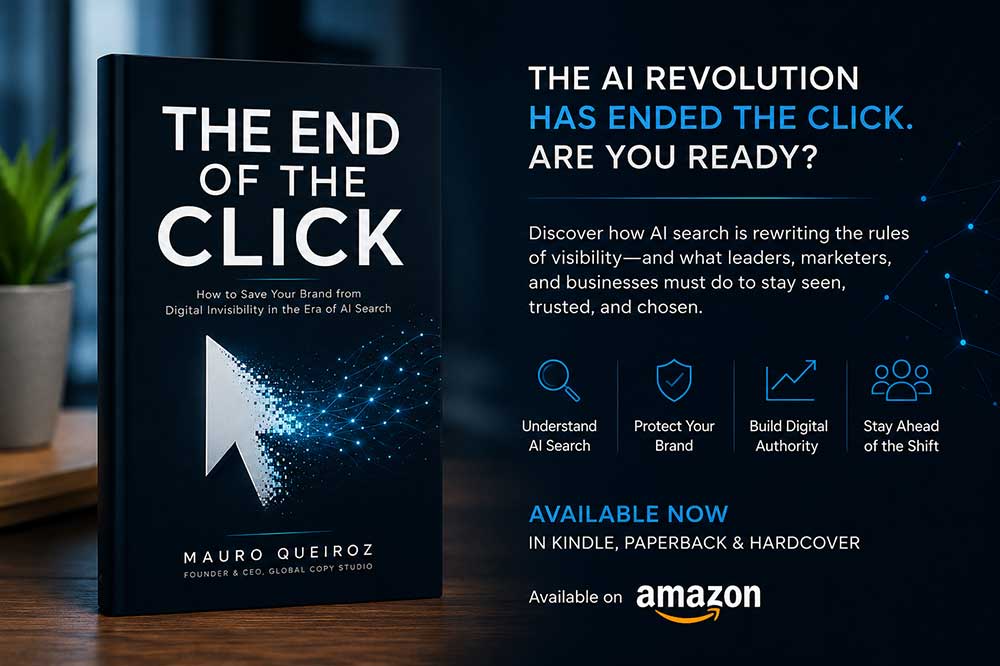
That is the central idea behind my book, The End of the Click ↗.
The Internet Is Learning to Answer
Think about how most people used Google for years. You typed a question, Google displayed a list of websites, and you decided which one to visit. Someone looking for an accountant, for example, might search for “best accountant for small business,” open several websites, compare them and eventually make a decision.
Artificial intelligence is changing that process. Someone can now ask an AI assistant to compare accounting software, explain which type of accountant might be appropriate for a particular business, summarize differences between products, or help research companies before deciding which websites are worth visiting.

The technology is doing part of the research people once had to do themselves. The old journey was usually:
Question → Google results → Website → Answer
Increasingly, the journey can become:
Question → AI → Answer
Sometimes a click happens afterward. Sometimes it doesn’t. That difference matters enormously to businesses.
What Is a Zero-Click Search?
A zero-click search is simply a search in which the user gets what they need without clicking through to a website. This existed long before generative AI because Google has displayed weather information, definitions, maps, featured answers and other information directly in search results for years.
AI has expanded what can happen before the click. Instead of receiving only a list of pages to investigate, someone may receive a summarized explanation, comparison or set of options and then decide whether further research is necessary.
Imagine asking: What is the best CRM for a small marketing agency? An AI assistant might discuss several products, compare their strengths and explain why different options may suit different types of companies.
The customer may still visit one or more of those companies afterward. But by then, something important may already have happened: some companies were included in the research while others were not.
For businesses, that creates a new kind of competition.
Ranking and Being Recommended Are Different Things
Traditional SEO focused heavily on rankings. If your website appeared near the top of Google, you had a better opportunity to receive the click. Businesses therefore invested in keywords, backlinks, website performance, content and other forms of search engine optimization.
Those things still matter. But an AI-generated answer introduces another challenge because search-enabled AI systems can work with information found across multiple sources. A company may therefore have an excellent website while much of the evidence behind its real-world expertise and reputation remains difficult to discover elsewhere online.
This is one of the most important distinctions I make in The End of the Click: good SEO can help machines read your expertise. It does not automatically make your company recommendable.
A company may genuinely deserve trust while the digital world contains too little information to understand why. This is where Digital Reputation ↗ becomes increasingly important. What a company says about itself matters, but so can reviews, professional profiles, interviews, articles, independent references, public information and other evidence that helps represent what the business has actually earned and accomplished.
Your Website Cannot Tell the Whole Story Alone
Every business says positive things about itself. Companies describe themselves as experienced, innovative, trustworthy and customer-focused. There is nothing wrong with that, but those statements alone provide a limited picture of how the company is known beyond its own website.
Think about how you would choose a professional yourself. If a lawyer tells you, “I’m one of the best lawyers in the city,” you probably would not make an important decision based only on that sentence. You might look at credentials, reviews, articles, professional history, independent references or other information before reaching your own conclusion.
The same principle matters in digital discovery. A website remains one of the most important sources of information about a company, and businesses should not neglect it simply because AI Search is growing. But the website is only one part of the company’s digital presence.
The objective is not to make AI “trust” your marketing claims. It is to make enough clear and genuine information available for people and machines to better understand who you are, what you know and what your business has actually done.
Does This Mean SEO Is Dead?
No. In fact, abandoning SEO because of AI Search would misunderstand what is happening. Search engines and AI systems still need to discover pages, understand information and connect that information to people, organizations, products, services and subjects.
A machine should be able to answer basic questions about your business without unnecessary confusion. What does your company do? Where does it operate? Who are the people behind it? What services does it provide? What subjects do those people genuinely understand?
This is where website structure, clear writing, internal links, technical SEO and structured data remain useful. Schema sounds technical, but its purpose is relatively simple: it helps label information so machines have additional clues about what that information represents.
The broader challenge is no longer merely optimizing for a traditional search-results page. AI Search Optimization ↗ means making a business easier to discover, understand and evaluate across a search environment increasingly influenced by artificial intelligence.
Write Like You Are Answering a Customer
Content also needs to become easier to understand. Many business websites begin with paragraphs of marketing language before answering the question that brought the visitor to the page.
Imagine someone searching: How much does a dental crown cost? That person probably does not want to begin by reading that the practice has been “committed to creating beautiful smiles for fifteen years.” The person wants an answer.
A useful page can answer the question first and then explain prices, materials, options, insurance, exceptions and anything else the customer needs to understand the subject properly.
This approach works for people because they get useful information quickly. It also gives search engines and AI systems clearer information about what the page actually explains.
AI Is Making Real Experience More Valuable
Artificial intelligence has made content incredibly easy to produce. A business can now generate dozens of articles in a day. But millions of other businesses have access to the same capability.
When everyone can produce generic content, generic content stops being special. What remains difficult to reproduce is the knowledge that comes from actually doing the work: your experience, data, opinions, cases, mistakes, discoveries, decisions and lessons learned over years of solving real problems.
Before publishing an article, I believe businesses should ask themselves a simple question:
Could an AI have written this without knowing anything about our company?
If the answer is yes, the article probably contributes very little evidence of what your company actually knows or has experienced. This is why generic content is losing much of its strategic value ↗ in a world where producing more words has become extraordinarily easy.
A consultant explaining what twenty years of client work taught her has something distinctive. A company publishing genuine data from hundreds of projects has something distinctive. A specialist challenging conventional advice because years of professional experience led to a different conclusion has something distinctive.
AI can help organize, develop and communicate that knowledge. But the knowledge needs to come from somewhere real.
Traffic Is No Longer the Only Measure of Visibility
For many years, businesses measured online success primarily through website traffic. More visitors generally meant more opportunities to generate leads and sales. Traffic remains useful, but it can no longer describe every part of the customer journey.
Imagine that someone asks an AI assistant for companies capable of solving a particular problem. The person learns about your company there and later searches directly for your name. Analytics may record the eventual website visit, but part of the discovery process happened before that visit.
This means businesses need to look beyond one question—“How much traffic did our website receive?”—and consider another: “Can our company be discovered and understood when people use AI to research our industry?”
The objective is not simply to appear somewhere inside an AI-generated answer. What matters is whether the digital environment contains enough genuine and understandable information for your expertise and reputation to be properly represented when relevant questions arise.
The Click Is Not Dead
The title The End of the Click is deliberately provocative, but the argument is not that people will stop clicking websites. They won’t. The real change is where the click happens in the customer’s decision-making process.
In the old model, customers often clicked first and learned about the company afterward. In the emerging model, they may learn about a company through an AI system first and visit its website later to investigate further, verify information, understand its services or make contact.
That changes the role of the website.
Your website may increasingly become the place where customers confirm a decision rather than the place where they first discover you. That does not make the website less important. In many cases, it makes the quality, clarity and credibility of the website even more important because the visitor may arrive already knowing something about the company.
The End of the Click explores this shift in greater depth and provides a practical framework for businesses that want to adapt to AI Search without abandoning everything they already know about SEO.
Ultimately, the issue comes down to one simple question:
When someone asks an AI who to trust in your industry, will it know your name?


