



AT A GLANCE
Prompt Engineering became an industry not because AI became harder to understand, but because effective prompting depends on two older human skills: expressing an idea clearly and reasoning it through before asking for an answer. Many people have simply had less practice with both. What looks like a technical gap is, underneath, a vocabulary gap and a reasoning gap. AI did not create either one. It simply revealed them.
The Symptom
In the last two years, “Prompt Engineering” courses have multiplied everywhere—promising to teach people how to “talk” to ChatGPT, Gemini, or Claude. On the surface, this looks like a new technical skill for a new technology. Look closer, and the pattern is older than AI itself: people who struggle to write a clear paragraph will also struggle to write a clear prompt. The machine didn’t create the problem. It exposed it, instantly and at scale, because it has no patience for vagueness and no ability to guess what a person meant but didn’t say. [1][2]
For the first time in history, we are being evaluated not by what we know, but by how clearly we can express what we know.
A Trend Worth Looking At
The rise of Prompt Engineering as a profession did not happen in isolation. At roughly the same time that organizations began investing heavily in AI literacy, researchers were already documenting a decades-long debate about changes in reasoning ability across generations. These two trends are not proof of a cause-and-effect relationship, but they raise an important question: why has communicating clearly with a machine become valuable enough to create an entirely new industry?
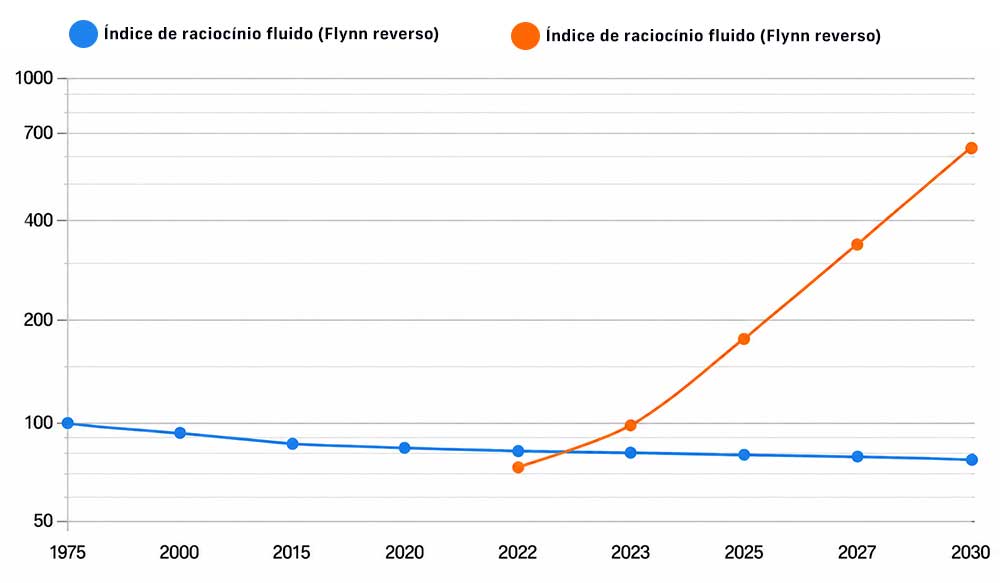
Figure 1. Indexed comparison between projected Prompt Engineering market growth and the Reverse Flynn Effect. Both series are normalized (2023 = 100) to illustrate relative trends rather than absolute values. The orange line represents the projected Prompt Engineering market, while the blue line represents an indexed cognitive trend based on published research.
AI doesn’t reward better prompts. It rewards better thinking
Root Cause One: A Vocabulary Left Unpracticed
Many young people today grew up messaging in slang and abbreviations, consuming video and audio sped up to 1.5x or 2x, and increasingly preferring to listen or watch rather than read. Each of these habits, on its own, is harmless. Together, they add up to less practice with something specific: turning a vague thought into a precise sentence. [3][4]
Add to this a generation more comfortable with online interaction than face-to-face conversation, and the compounding effect becomes clearer: less practice expressing nuance to people means less practice expressing nuance to anything, including a machine that takes language literally.

An AI model is, fundamentally, a mirror for that skill. It cannot fill in what a vague prompt leaves out. It cannot guess unstated context the way a patient friend might. When the input lacks clarity, the output lacks quality—and the person on the other end concludes the tool is difficult, when the real gap is their own unpracticed ability to articulate a thought in full sentences. [1][2]
Root Cause Two: A Reasoning Muscle Left Idle
Here is the deeper layer. AI is called “artificial intelligence” for a reason — it responds to intelligence with intelligence. It rewards a mind that has already done some of the reasoning before typing: breaking a fuzzy goal into parts, deciding what matters, anticipating what’s missing. That is not a skill invented by chatbots. It is the same reasoning ability that has driven human discovery since civilization began.
Is that ability actually declining? The evidence here is genuinely debated among researchers, and it deserves to be presented carefully rather than as settled fact. For most of the twentieth century, average IQ scores rose steadily across generations—a well-documented pattern known as the Flynn Effect. But in several developed countries, including Norway, Denmark, the UK, and France, that trend has slowed or reversed since the 1990s and 2000s, a shift researchers call the Reverse Flynn Effect. One large study of Norwegian conscripts found the turning point occurred for cohorts born after roughly 1975, with losses equivalent to several IQ points per generation since. [5]
The detail that matters most for this argument is that the decline shows up mainly in fluid intelligence — the ability to reason through something new — rather than in crystallized knowledge, or what people already know. That distinction suggests reduced cognitive exercise, not reduced potential. Researchers have proposed several contributing factors: education systems that reward memorization over analysis, digital environments that favor skimming over sustained attention, and a growing habit of outsourcing memory and problem-solving to devices rather than practicing them internally. [5][6][7]
None of this is closed science. Causes remain disputed, results vary by country and by cognitive category, and it would be a mistake to treat any single study as the final word. But the direction of the pattern lines up with what this article has already argued about vocabulary: the issue isn’t that people were born with less capacity. It’s that a specific kind of mental exercise—sustained, linear reasoning worked all the way through—has quietly become optional in daily life, right up until an AI model asks for it directly.
Artificial intelligence didn’t create the communication problem. It simply became the first listener incapable of pretending it understood us.
Why This Matters Beyond AI
This isn’t really a story about artificial intelligence. It’s a story about human intelligence—specifically, the muscle of turning a fuzzy idea into a clear one and the muscle of reasoning that idea through before acting on it. Both used to get exercised constantly: in essays, in debates, in letters, in slow conversations with people who couldn’t be swiped away. AI didn’t invent the need for these skills. It simply made their absence visible, measurable, and — for the first time — billable as a course.
What Mentors, Parents, and Teachers Can Do
The good news: the situation is fixable, and the fix doesn’t require new technology—just old habits, reintroduced deliberately.
Read before you prompt. Reading builds vocabulary and sentence structure faster than any other habit. Fifteen minutes with a real book does more for prompting ability than any course. [3][4]
Write it out first. Before typing into an AI tool, have students or children write down, in a full sentence, exactly what they want and why. The habit of specificity transfers directly.
Think before you search. Encourage working through a problem on paper, even briefly, before reaching for an answer engine. The goal isn’t to avoid AI—it’s to keep the reasoning muscle active alongside it.
Slow down the audio. Encourage listening at normal speed sometimes; comprehension and patience are trained together. [8][9]
Protect real conversation. Face-to-face dialogue, where a hard sentence can’t be skipped, is still the best trainer for expressing complex thoughts clearly.
Reframe the goal. Don’t teach “how to prompt an AI.” Teach how to think clearly and say precisely what you mean—the AI skill comes free with that.
Conclusion
Prompt Engineering, as a discipline, isn’t fake—large language models do have quirks worth understanding, and structured techniques genuinely improve results. But for most people struggling with it, the missing piece isn’t a technical trick. It’s the vocabulary, patience, and reasoning built by reading, writing, thinking things through, and talking to other humans, not machines. The Reverse Flynn Effect suggests this erosion has been happening quietly for decades—long before anyone had heard of a chatbot. AI didn’t cause it. It just handed us the mirror, and asked us, for the first time, to look.
References
[1] Yang, C., Shi, Y., Ma, Q., Liu, M. X., Kaestner, C., & Wu, T. (2026). What Prompts Don’t Say: Understanding and Managing Underspecification in LLM Prompts. Findings of the Association for Computational Linguistics (ACL 2026).
[2] Salinas, A., & Morstatter, F. (2024). The Butterfly Effect of Altering Prompts: How Small Changes and Jailbreaks Affect Large Language Model Performance. Findings of ACL 2024.
[3] Cain, K., Oakhill, J., & Lemmon, K. (2011). Individual Differences in Vocabulary Development and Reading Comprehension. Journal of Educational Psychology.
[4] Mol, S. E., & Bus, A. G. (2011). To Read or Not to Read: A Meta-Analysis of Print Exposure From Infancy to Early Adulthood. Psychological Bulletin.
[5] Bratsberg, B., & Rogeberg, O. (2018). Flynn Effect and Its Reversal Are Both Environmentally Caused. Proceedings of the National Academy of Sciences (PNAS).
[6] Risko, E. F., & Gilbert, S. J. (2016). Cognitive Offloading. Trends in Cognitive Sciences.
[7] Delgado, P., Vargas, C., Ackerman, R., & Salmerón, L. (2018). Don’t Throw Away Your Printed Books: A Meta-Analysis on the Effects of Reading Media on Reading Comprehension. Educational Research Review.
[8] Caron, J., et al. (2018). Effect of Increased Video Playback Speed on Learning in Medical Students. Medical Education Online.
[9] Nagashima, T., et al. (2022). Influence of Video Playback Speed on Learning Performance and Cognitive Load. Computers & Education.