A growing and curated collection of original thoughts on SEO, AEO, GEO, and Web Content Optimization (WCO) by Mauro Queiroz and Global Copy Studio contributors. These quotes explore how search optimization evolves as technologies, platforms, and the Web itself continue to change. The collection is regularly updated as new ideas are published.
What Are SEO, AEO, GEO & Web Content Optimization Quotes?
SEO, AEO, GEO and Web Content Optimization quotes explore how content must evolve as search engines, answer engines and generative AI systems change the way information is discovered, understood and recommended. They reflect the broader principle of Web Content Optimization (WCO): preparing content for the technologies and digital environments through which people access information.
“SEO can help people discover your business, and tools like Semrush or Ahrefs can help improve visibility. But neither can manufacture the history behind the reputation your business has earned.” — Mauro Queiroz ↗
“SEO can improve the visibility of evidence, but visibility and reputation are not the same thing.” — Mauro Queiroz ↗
“Optimization helps evidence travel. It does not replace the evidence.” — Mauro Queiroz ↗
“Structured data can help machines understand what your evidence means, but it cannot make weak evidence stronger.” — Mauro Queiroz ↗
“SEO can help you become discoverable. It cannot decide whether what people discover deserves a recommendation.” — Mauro Queiroz ↗
“Structured data can help machines understand information. It cannot manufacture the reputation behind that information.” — Mauro Queiroz ↗
“AI Search Optimization should help machines find, understand, connect, and evaluate genuine evidence. It should not be treated as a shortcut for manufacturing credibility.” — Mauro Queiroz ↗
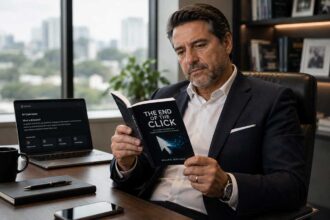
“The end of the click is not the end of the website. It is the beginning of a much more demanding website.” — Mauro Queiroz ↗
“Fewer clicks do not mean that search engines and AI systems need less information about your company.” — Mauro Queiroz ↗
“The click may be becoming less certain. The need for reliable digital information is not.” — Mauro Queiroz ↗
“Content is not decoration.” — Mauro Queiroz ↗
“You do not need to feed AI more noise. You need to give it better evidence.” — Mauro Queiroz ↗
“The website is therefore not dying. The old way of building websites is becoming inadequate for the jobs websites now need to perform.” — Mauro Queiroz ↗
“The objective is not simply to create another website, but to make the company’s real knowledge, experience, and evidence easier for people, search engines, and AI systems to discover and understand.” — Mauro Queiroz ↗</strong
“SEO, AEO and GEO cannot manufacture experience.” — Mauro Queiroz ↗
“But optimization cannot create a history that never happened.” — Mauro Queiroz ↗
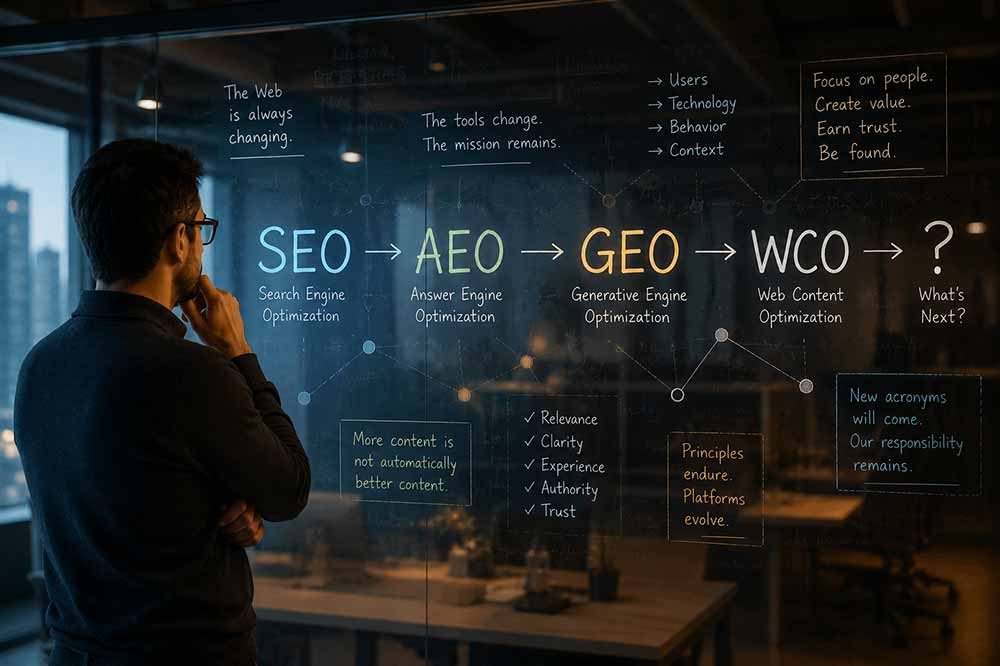
“SEO will change. AEO and GEO may be replaced by new acronyms. Search interfaces will change, and today’s AI systems will certainly evolve.” — Mauro Queiroz ↗
“Just as programming logic allowed me to adapt to new languages, WCO provides a way of thinking that can adapt to whatever technologies, platforms and optimization disciplines the Web introduces next.” — Mauro Queiroz ↗
“I don’t think that use was wrong. I think we came to understand the term too narrowly.” — Mauro Queiroz ↗
“Making a JPEG smaller was Web Content Optimization. Making a page easier for Google to understand is Web Content Optimization. Structuring an answer for AI systems can be Web Content Optimization too.” — Mauro Queiroz ↗
“These questions belong at the beginning of the process, not at the end.” — Mauro Queiroz ↗
“From the client’s perspective, something simpler has happened: The Web changed, so the work required to properly prepare their content for the Web changed too.” — Mauro Queiroz ↗
“We should learn the methods that prove useful, discard those that don’t and add the valuable ones to our professional toolbox. But we shouldn’t confuse the latest tool with the enduring discipline.” — Mauro Queiroz ↗
“The question is no longer simply whether your content can rank. It is whether your content gives people and machines a reason to trust the organization behind it.” — Kellen Reed ↗
“SEO, AEO, GEO, and other optimization techniques can help make that evidence discoverable and understandable. They do not create the reputation behind it.” — Mauro Queiroz ↗
“These techniques do not create expertise, experience, or reputation. They help make evidence of them easier for people and machines to discover, connect, and understand.” — Kellen Reed ↗
“That kind of reputation cannot be created by a plugin, a backlink strategy, or an AI optimization technique.” — Mauro Queiroz ↗
“Optimization does not create reputation. It helps make evidence of reputation accessible and understandable.” — Mauro Queiroz ↗
“The acronyms may change again. What matters is the larger movement: we are moving from optimizing only for ranking toward preparing information to be found, understood, evaluated, and used in answers.” — Mauro Queiroz ↗
“Optimization can improve the visibility of evidence. It cannot manufacture the history behind it.” — Mauro Queiroz ↗
“WCO helps prepare the content and evidence so it can travel through the web environment of today—and whatever comes next.” — Kellen Reed ↗
“We were optimizing content for the Web we had at the time.” — Mauro Queiroz ↗
“The question changed from simply ‘Can we build this?’ to ‘Should we put this on the page?’” — Mauro Queiroz ↗
“The toolbox became larger because the Web became more complex.” — Mauro Queiroz ↗
“Different environments require different techniques. The underlying logic remains the same.” — Mauro Queiroz ↗
“The technologies changed. The underlying responsibility didn’t: prepare content for the Web as the Web exists at that moment.” — Mauro Queiroz ↗
“Whatever Comes Next doesn’t replace WCO. It changes what WCO requires.” — Mauro Queiroz ↗
“Optimization should not be something sprayed over finished content at the end of production.” — Mauro Queiroz ↗
“WCO should influence the decision to create the content in the first place.” — Mauro Queiroz ↗
“The business owner should not need to decide whether an article requires SEO, AEO, GEO, Entity SEO or whatever acronym arrives next. That is our responsibility as professionals.” — Mauro Queiroz ↗
“WCO therefore isn’t only about rankings. It is also about asking what each piece of content contributes to the larger picture.” — Mauro Queiroz ↗
“More content is not automatically better content, just as adding another JavaScript carousel did not automatically make a website better twenty years ago.” — Mauro Queiroz ↗
“The acronyms will change. The methods will evolve. The platforms will come and go. But as long as we publish content on the Web, we will need to prepare it for the Web we have.” — Mauro Queiroz ↗
“Ranking a webpage is not the same thing as building a reputation.” — Mauro Queiroz ↗
“If your expertise isn’t documented and discoverable, you are giving both humans and machines very little evidence to work with.” — Mauro Queiroz ↗
“There is no special button that makes someone an authority in AI Search.” — Mauro Queiroz ↗
“If executive ghostwriting is intended to build digital reputation and discoverable expertise, AI Search cannot be an afterthought. It has to be considered from the beginning of the editorial process.” — Mauro Queiroz ↗
“AEO isn’t simply adding a FAQ section to an article, and SGEO isn’t inserting a collection of phrases in the hope that an AI system notices them.” — Mauro Queiroz ↗
“Good SEO can help machines read your expertise. It does not automatically make your company recommendable.” — Mauro Queiroz ↗
“The goal is not to impress the machine with complicated code. The goal is to remove confusion.” — Mauro Queiroz ↗
“The basic idea is simple: answer the question first, then provide the explanation.” — Mauro Queiroz ↗
“Your website may increasingly become the place where customers confirm a decision rather than the place where they first discover you.” — Mauro Queiroz ↗
“The Zero-Click Problem is the growing gap between ranking well in search engines and actually receiving website visitors because AI systems increasingly answer users’ questions without requiring them to click a website.” — Kellen Reed ↗
“The goal wasn’t simply helping Google crawl the website.” — Kellen Reed ↗
“It was making the business and the evidence behind its expertise easier for people and machines to understand.” — Kellen Reed ↗
“SEO can optimize what exists. It cannot recover a history that was never documented.” — Mauro Queiroz ↗
“The next generation of optimization will depend increasingly on the quality of the evidence available to optimize.” — Mauro Queiroz ↗
“The goal is no longer just visibility. Information also needs to be clear, useful, contextualized, and supported by credible evidence.” — Mauro Queiroz ↗
“Green SEO scores do not guarantee business growth.” — Kellen Reed ↗
“The SEO score is not your strategy.” — Kellen Reed ↗
“SEO plugins are assistants, not strategists.” — Kellen Reed ↗
“A plugin can tell you whether a keyword appears in a title. It cannot tell you whether that keyword represents the question your customer actually needs answered.” — Kellen Reed ↗
“Optimization is a tool. Strategy decides what deserves to be optimized.” — Kellen Reed ↗
“The objective is not to make the plugin happy. The objective is to make the content useful, discoverable, understandable, and credible.” — Kellen Reed ↗
“Ranking is a visibility signal. It is not proof of expertise.” — Kellen Reed ↗
“Search optimization can help content become discoverable. It cannot make generic thinking original.” — Kellen Reed ↗
“The goal is no longer simply to produce content that algorithms can find. It is to produce evidence that people and machines have a reason to value.” — Kellen Reed ↗
“The technology is changing, but the principles behind great digital visibility remain surprisingly consistent.” — Mauro Queiroz ↗
“The house hasn’t changed. The visitors have.” — Mauro Queiroz ↗
“The principles are familiar. The presentation is evolving.” — Mauro Queiroz ↗
“SEO is the foundation. It helps search engines discover, organize, and understand your website.” — Mauro Queiroz ↗
“AEO and GEO represent another layer. They help organize and present information and evidence so people and AI systems can understand and use it more easily.” — Mauro Queiroz ↗
“People are no longer searching the internet. They are starting to have conversations with it.” — Mauro Queiroz ↗
“The goal is no longer just attracting clicks. It is becoming the answer.” — Mauro Queiroz ↗
“Search engines helped customers find websites. AI is helping customers choose businesses. Those are not the same objective.” — Mauro Queiroz ↗
“Ranking remains valuable, but ranking alone no longer describes the entire discovery process.” — Mauro Queiroz ↗
“The future of search is not simply about ranking higher. It is about becoming easier for machines and people to understand.” — Mauro Queiroz ↗
“SEO helps make information discoverable. AEO helps make answers accessible. GEO helps generative systems understand the context behind those answers.” — Mauro Queiroz ↗
“Ranking well and being recommended are no longer exactly the same thing.” — Kellen Reed ↗
“What has changed is that discoverability alone is no longer enough.” — Kellen Reed ↗
“Most companies learned how to become visible inside Google’s ranking system. Very few learned how to make the history and evidence behind their reputation equally visible.” — Mauro Queiroz ↗
“The industry did not fail because it taught SEO. It fell behind because it treated SEO as the final destination rather than one stage in a much larger journey.” — Mauro Queiroz ↗
“SEO, AEO, GEO, structured data, entity relationships, expert authorship, and information architecture can then help people, search engines, and AI systems discover, connect, and understand that evidence.” — Mauro Queiroz ↗
“Being discoverable in today’s AI-powered search environment requires more than producing more content.” — Mauro Queiroz ↗
“Real expertise needs to be documented clearly, connected to the person or organization behind it, and structured so that people, search engines, and AI systems can find and understand the evidence.” — Mauro Queiroz ↗
“If AI systems increasingly mediate how people find information, the ability to explain expertise clearly becomes part of being discoverable.” — Kellen Reed ↗
“Technology will continue to evolve, and new acronyms will undoubtedly appear. The businesses that thrive won’t be the ones chasing every new trend. They’ll be the ones consistently documenting their expertise, answering real customer questions, preserving evidence of what they have actually done, and making that evidence accessible to both people and machines.” — Mauro Queiroz ↗
“Optimization can help evidence travel. It cannot create the experience behind that evidence.” — Kellen Reed ↗